Author: Things Well Chosen

  • Best Over-the-Sink Cutting Boards for Small Kitchens

    Best Over-the-Sink Cutting Boards for Small Kitchens

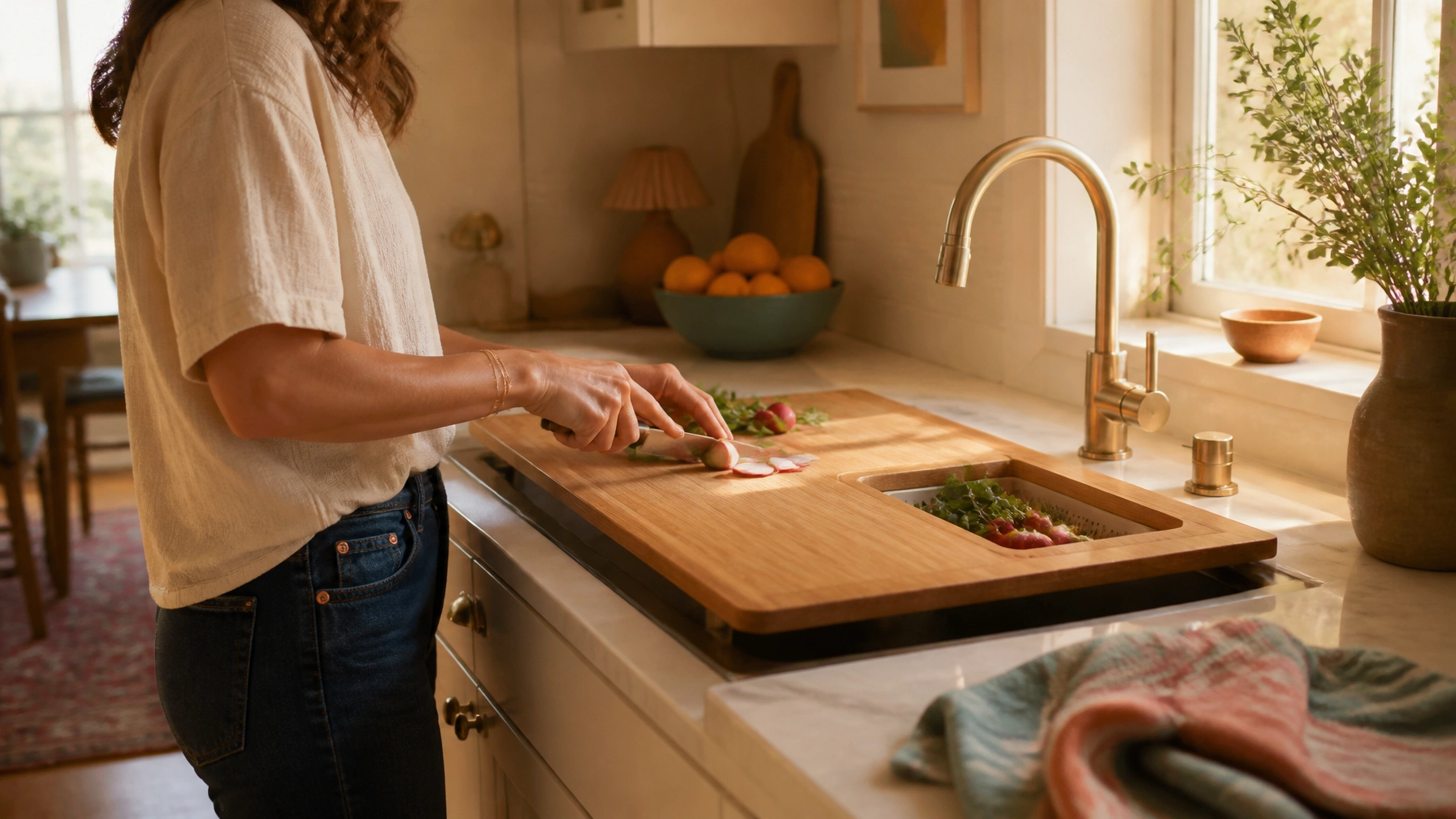
    An over-the-sink cutting board can add useful prep space to a small kitchen, but only if it fits securely and leaves enough room to work. The wrong board can wobble, block the faucet, cover too much of the sink, or introduce a collection of accessories that are harder to clean than they are useful.

    This is a researched buying guide, not a firsthand product test. We prioritized products with clearly documented materials, construction, fit requirements, and current U.S. availability, and we flag where important sizing information still needs confirmation. The shortlist is intentionally small because the differences between these products matter more than the number of options.

    Disclosure: This article contains affiliate links. As an Amazon Associate, Things Well Chosen earns from qualifying purchases at no additional cost to you.

    Our Shortlist

    The most important decision is not material, color, or accessory count. It is fit. A beautifully made board that does not sit securely is a bad purchase.

    Quick Comparison

    ProductBest forMaterialSizeAdjustable?Useful extraMain tradeoff
    Dexas Over-the-Sink Strainer BoardConventional sinks / easy cleanupPoly board20 × 11.5 × 1 in.No2.5-qt collapsible strainerFixed span
    Crate & Barrel Over-the-Sink BoardDesign-conscious kitchensRichlite paper compositeConfirm before purchaseNo adjustment listedCollapsible silicone/steel colanderHand-wash only; availability may be limited
    KRAUS KCB-WS301SACompatible KRAUS workstation sinksWood-grain composite16⅞ × 11 × ¼ in.NoNoneSink-specific
    Lipper International #8841Wider sinks / adjustable fitBamboo23.75 × 11.5 × 0.75 in. closed; expands to 34 in.YesNoneLarger storage footprint; hand-wash

    Dimensions and features can change by model, color, or retailer. Confirm the current product page before ordering.

    1. Dexas Over the Sink Poly Cutting Board: Best Practical Choice for a Generic Sink
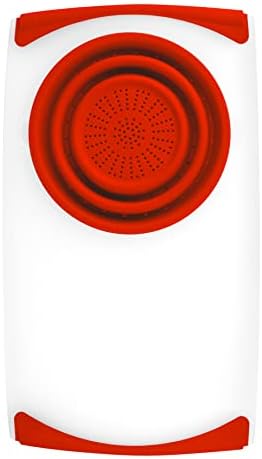
    Dexas over-the-sink plastic cutting board with removable colander

    The Dexas Over the Sink Poly Cutting Board with Collapsible Colander Strainer is the most straightforward option on this list. It is designed as a standalone over-the-sink board rather than as an accessory for one particular sink system.

    Why we selected it

    The design concentrates on two useful functions: a cutting surface and a removable strainer. The board measures 20 inches long by 11.5 inches wide and 1 inch thick. Its non-slip rubber edges are intended to grip the supporting surface, and the included strainer collapses for storage.

    The strainer has a documented 2.5-quart capacity and can also be used separately as a colander. The board is made from polyethylene, which Dexas describes as durable, non-porous, odor-resistant, and gentle on knives. The product listing also identifies the board and strainer as dishwasher safe.

    That combination makes more sense than many large accessory bundles. The colander has a clear purpose: rinse or drain produce directly over the sink.

    Who it suits

    This is the best fit for:

    • Renters or homeowners with a standard sink rather than a workstation sink
    • Kitchens where counter space is genuinely limited
    • Shoppers who prioritize easy cleanup over a furniture-like wood board
    • Anyone who wants an integrated strainer without committing to a sink-specific system

    Fit and construction

    The board is a fixed-size, rim-supported design. It does not use telescoping arms or a documented adjustment mechanism. Instead, the rubber edges are meant to grip the surfaces supporting the board.

    That makes the sink’s outside support width particularly important. Measure the area from one supporting edge to the other, not just the inside of the basin. Also check whether the sink rim is level and wide enough to support the board without rocking.

    What we like

    • Clear, useful accessory rather than an oversized bundle
    • Removable colander is easier to handle than a permanently attached insert
    • Dishwasher-safe construction simplifies cleanup
    • Fixed dimensions avoid the potential looseness of telescoping rails
    • Compact enough to store more easily than a large wood workstation

    Potential drawbacks

    The board is only 1 inch thick, and plastic will not have the visual or tactile presence of a substantial hardwood board. A raised edge and juice-channel design may also reduce the uninterrupted cutting area slightly.

    The board is not adjustable, so there is no substitute for measuring. A 20-inch length may work well across one sink but be awkward on another, especially if the counter lip is narrow, uneven, or interrupted by a double-basin divider.

    Who should skip it

    Skip the Dexas if you want a large, heavy wood surface for frequent batch preparation, or if your sink needs a board with adjustable arms. It is also not the right choice for a KRAUS workstation sink where a ledge-mounted accessory would provide a more secure fit.

    2. Crate & Barrel Over-the-Sink Colander and Cutting Board: Best for a More Refined Material Palette

    The Crate & Barrel Over-the-Sink Colander and Cutting Board is the most visually considered option in this group. Its cutting surface is made from Richlite paper composite, with a removable collapsible colander made from silicone and steel. Silicone feet are also listed as part of the design.

    Why we selected it

    The material choice sets it apart from the many bamboo-and-plastic combinations in this category. Richlite is a paper-based composite rather than wood, giving the board a darker, more architectural look while avoiding some of the care concerns associated with natural wood.

    The removable colander is a useful inclusion because it supports a real workflow: prepare ingredients on the board, move them into the colander, and rinse or drain them over the sink. It can also be removed when the full cutting surface is more useful.

    Who it suits

    This product is worth considering for:

    • Shoppers who want an over-sink board that feels less utilitarian
    • Kitchens where visible accessories need to coordinate with the room
    • Readers who prefer composite materials to bamboo
    • Anyone who values a removable prep accessory but does not need a large workstation kit

    Fit and construction

    Crate & Barrel describes the product as an over-the-sink board that fits over most sinks. However, the dimensions were not visible in the product information available for this review, and no adjustable span was documented.

    That limitation matters. Before ordering, confirm the current length, width, thickness, and support geometry directly with Crate & Barrel. Do not rely on the phrase “fits over most sinks” as a substitute for measuring your own sink.

    Treat it as a fixed, rim-supported design unless the current listing states otherwise. Check faucet clearance, the depth of the counter lip, and whether the board would interfere with a sink divider.

    What we like

    • Richlite composite is a distinctive alternative to bamboo or basic plastic
    • Removable colander serves a clear purpose
    • Silicone feet are intended to help keep the board in place while you work.
    • Less visually busy than many overbuilt workstation kits

    Potential drawbacks

    The lack of readily visible dimensions makes this a more difficult recommendation to buy confidently. A product can be well designed and still be wrong for your sink.

    Crate & Barrel currently lists this board as hand wash only, making it less convenient than the Dexas if dishwasher cleanup matters to you. It is also currently listed on clearance, so availability may be limited.

    Who should skip it

    Skip this option if you need a highly adjustable board, if your sink has unusual support geometry, or if you want exact fit information before making a purchase. It is also not the best choice for someone who wants the least expensive functional solution.

    3. KRAUS KCB-WS301SA: Best for a KRAUS Workstation Sink with More Prep Area

    KRAUS wood-grain composite workstation cutting board

    The KRAUS KCB-WS301SA Workstation Kitchen Sink Wood Grain Composite Cutting Board is not a universal over-the-sink board. It is a dedicated accessory for compatible KRAUS workstation sinks.

    Why we selected it

    For the right sink, a ledge-mounted board can be more secure and more integrated than a generic board resting on the rim. The KCB-WS301SA measures 16⅞ inches long by 11 inches wide and ¼ inch thick. Its wood-grain composite construction provides a broad, shallow prep surface that sits on the sink’s integrated workstation ledge.

    It is a good example of why a sink system can be more useful than a generic accessory: provided you already have the compatible geometry.

    Who it suits

    Choose this board if:

    • You already own a KRAUS workstation sink
    • Your sink’s specifications list the KCB-WS301 or KCB-WS301SA as a compatible accessory
    • You want a relatively broad work surface over the sink
    • You prefer composite construction to natural bamboo

    Fit and construction

    The board is designed to sit on the integrated ledge of a KRAUS workstation sink. It does not expand, telescope, or use extendable arms.

    Do not purchase it based on length alone. KRAUS states that its workstation cutting boards are intended for the company’s workstation sink line, and compatibility varies by sink model. A sink with a similar opening may still lack the ledge depth or support points required by the board.

    What we like

    • Dedicated ledge support can provide a cleaner fit than a generic rim board
    • 11-inch depth gives useful everyday prep space
    • Composite construction avoids natural-wood maintenance
    • No unnecessary colander or accessory bundle to store

    Potential drawbacks

    The board is only ¼ inch thick, so it is a different proposition from a thick butcher-block-style board. It also has no included strainer or bowl. That is a benefit for simplicity, but not if your primary reason for buying an over-sink board is rinsing ingredients.

    Most importantly, it is not a general-purpose board for any sink.

    Who should skip it

    Skip it if you do not have a compatible KRAUS workstation sink, or if you need a board that can move between kitchens. If you are still choosing a sink, treat the board as one part of a larger workstation system rather than as a standalone purchase.

    4. Lipper International Bamboo Over-the-Sink Expandable Cutting Board: Best Adjustable Option

    The Lipper International Bamboo Over-the-Sink Expandable Cutting Board is the most flexible choice here for kitchens that need more span than a fixed board can provide.

    Why we selected it

    Unlike the fixed boards above, the Lipper expands from 23.75 inches wide to 34 inches wide. It measures 11.5 inches deep and 0.75 inch thick, with a cutting-board section measuring 20.5 by 9.25 inches.

    That adjustability makes it useful for readers whose sinks are too wide for a fixed 20-inch board or who want a board that can also span part of a stovetop or counter area.

    Who it suits

    This is worth considering for:

    • Wider sinks that need more than a fixed 20-inch span
    • Readers who want an adjustable rather than sink-specific design
    • Kitchens where a substantial bamboo work surface is useful
    • Anyone willing to trade easier fit flexibility for additional storage size and wood maintenance

    Fit and construction

    The board expands to a maximum width of 34 inches. Do not assume that means it will fit every sink up to 34 inches; measure the actual support points and make sure enough of the board or extension mechanism will rest securely on both sides.

    The bamboo construction requires more care than a dishwasher-safe plastic board. The manufacturer specifies hand washing with mild soap and cool water, thorough drying, no soaking, and occasional treatment with food-safe mineral oil.

    What we like

    • Much broader fit range than the fixed-size boards
    • Substantial bamboo work surface
    • No collection of accessories to store
    • Can create temporary work space over a sink or other suitable surface

    Potential drawbacks

    Adjustability adds moving parts and the board is substantially larger to store than the Dexas. It is also not dishwasher safe, and bamboo requires more careful drying and maintenance.

    Who should skip it

    Skip it if a smaller fixed board already fits your sink securely, if dishwasher-safe cleanup is important, or if you do not have a practical place to store a board nearly 24 inches wide even when closed.

    How to Choose an Over-the-Sink Cutting Board

    Measure more than the sink opening

    Before comparing products, measure:

    1. Sink width : measure the relevant support span from left to right.
    2. Sink opening : measure the basin opening, not just the outer sink dimensions.
    3. Front-to-back dimensions : include the usable depth of the sink rim or workstation ledge.
    4. Surrounding counter lip : note whether the board will rest on stone, laminate, a narrow rim, or a recessed ledge.
    5. Faucet clearance : check the faucet base, handle movement, and any pull-down sprayer.
    6. Double-basin dividers : determine whether the divider can support the board or will cause rocking.
    7. Usable workspace : account for colanders, bowls, handles, and the part of the sink that will remain accessible once the board is installed.

    A product dimension is not automatically a fit dimension. The board may be 20 inches long, but the important question is where and how those 20 inches are supported.

    A piece of cardboard cut to the listed dimensions can help you visualize counter overhang and faucet interference. It cannot confirm load-bearing stability, but it can reveal whether the board would make your sink awkward to use.

    Choose the material based on maintenance

    • Plastic or polyethylene: Usually the easiest to clean, and the Dexas board reviewed here is listed as dishwasher safe. It is practical for produce preparation and households that prioritize low maintenance.
    • Bamboo: Offers a warmer appearance and a thicker, more traditional cutting-board feel. It requires more careful drying and should not be left immersed in water.
    • Composite: Can provide a slimmer, more architectural design with less natural-wood maintenance. Care instructions vary, so do not assume dishwasher safety or heat resistance without verification.

    Material quality matters, but it comes after fit and stability.

    Fixed versus adjustable designs

    Adjustable boards can span more sink widths, but adjustment mechanisms introduce additional parts that may flex, loosen, or collect food residue. A fixed board with broad, stable support can be the better design when it fits your sink precisely.

    If you choose an adjustable model, look for clearly published minimum and maximum dimensions. “Fits most sinks” is not enough information by itself.

    Simple board versus workstation system

    A simple board is usually easier to store and clean. A workstation system can offer better integration, but only when the sink has the intended ledges or support points.

    A colander is useful when you regularly rinse produce or drain ingredients directly over the sink. Extra bowls, trays, phone slots, knife holders, and storage features deserve more skepticism. Each accessory occupies space and adds another surface to wash.

    Plan for storage

    Measure the board when it is not in use. A 20-inch board may fit across the sink but not inside a standard cabinet. Thicker wood or bamboo boards often need to stand vertically, while collapsible accessories may reduce the total storage footprint.

    The best over-sink board is one you can put away without creating a second storage problem.

    Who Should Not Buy One

    An over-the-sink cutting board is probably not worth buying if you:

    • Already have enough counter space for a normal cutting board
    • Have a sink with a narrow, uneven, or poorly supported rim
    • Need unrestricted access to the entire sink throughout meal preparation
    • Frequently wash large cookware while cooking
    • Dislike storing a large board vertically or above the sink
    • Have a double-basin sink with a divider that cannot support the board securely
    • Prefer a dishwasher-only kitchen routine but are considering wood or bamboo
    • Would get more use from a narrow counter board, folding prep surface, or wall-mounted solution

    If the board blocks the faucet or turns a useful sink into an awkward shelf, it has not created workspace. It has only moved the inconvenience.

    The Things Well Chosen Recommendation

    For most readers with a conventional sink, the Dexas Over the Sink Poly Cutting Board with Collapsible Colander Strainer is the most sensible place to start. It has clear dimensions, a useful removable accessory, documented dishwasher-safe care, and no sink-specific workstation requirement.

    For readers who need an adjustable span, the Lipper International Bamboo Over-the-Sink Expandable Cutting Board is the more flexible choice, expanding from 23.75 inches to 34 inches wide. For owners of a compatible KRAUS workstation sink, the KCB-WS301SA offers a broad, integrated prep surface designed specifically for the workstation ledge.

    The Crate & Barrel option is worth considering for its refined composite material and restrained accessory set, but its dimensions should be confirmed before purchase. That is the larger lesson with this category: measure first, then choose the board that earns its space.

    For more ideas about making a small kitchen work harder without filling it with unnecessary equipment, see our guide to 7 Small-Kitchen Tools That Actually Earn Their Space and Small Kitchen Fixes That Make a Big Difference. Browse more practical recommendations in the Things Well Chosen Kitchen.
  • 7 Small-Kitchen Tools That Actually Earn Their Space

    7 Small-Kitchen Tools That Actually Earn Their Space

    A small kitchen does not necessarily need fewer useful tools. It needs fewer mediocre ones.

    Every cutting board, bowl, appliance, and organizer competes for limited drawer, cabinet, or counter space. That raises the standard. A tool should solve a problem you encounter often, replace more than one bulky item where appropriate, store efficiently, or noticeably improve cooking and cleanup.

    The seven categories below are worth considering because they can do more than look clever in a small space. None is universally right for every kitchen, though. The useful question is not whether a product saves space. It is whether it saves enough space and effort to justify the room it still takes up.

    For broader layout and organization ideas, see our guide to Small Kitchen Fixes That Make a Big Difference. This list takes a narrower view: tools that earn their physical place through repeated use.

    1. An over-sink cutting board or workstation

    The problem it solves: You need more prep surface but have little or no counter space.

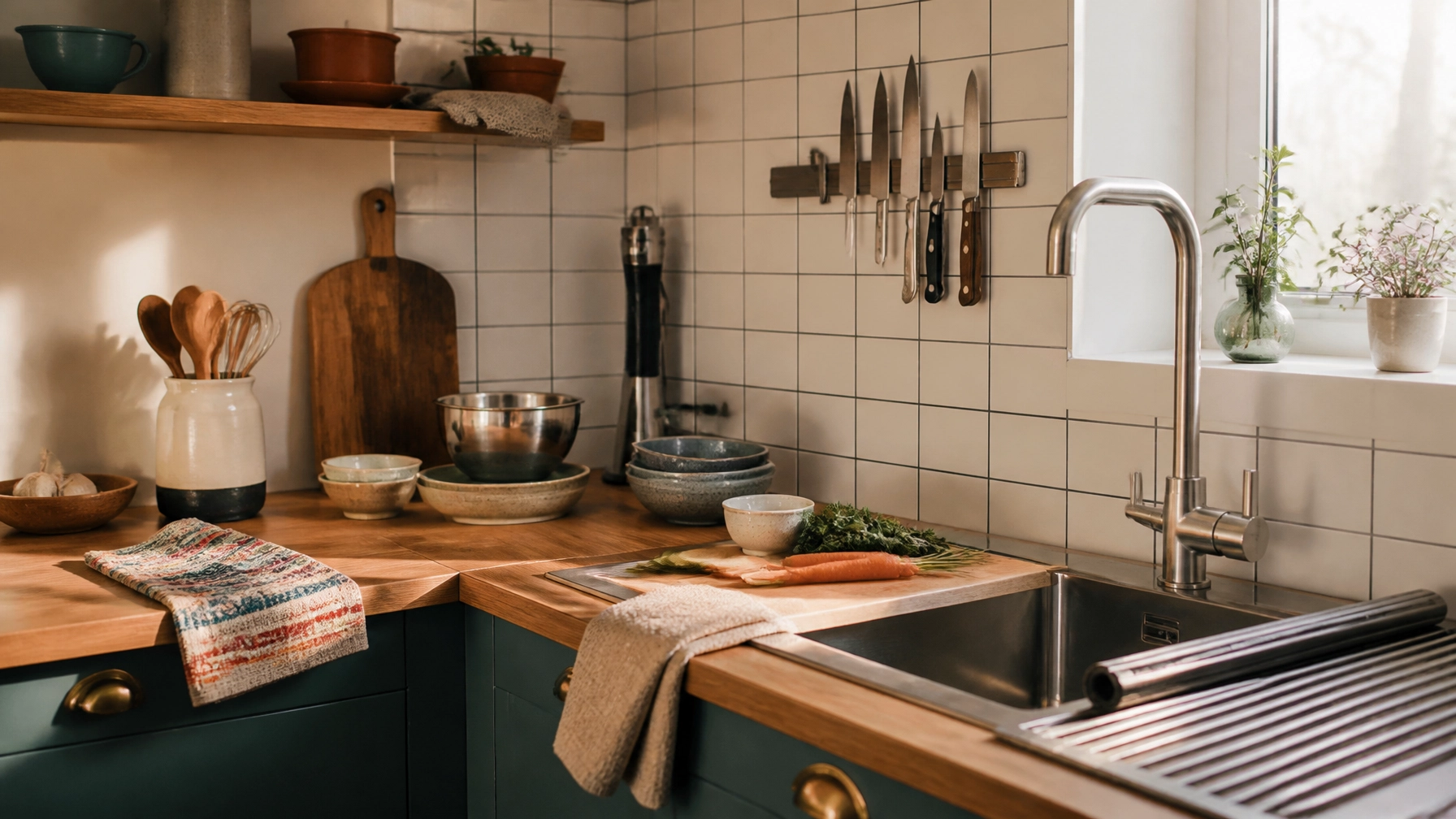
    An over-sink cutting board turns the sink into temporary workspace. Depending on the design, it may also hold a colander or bowl for rinsing produce and collecting scraps. That combination can make meal prep more comfortable without requiring a permanent counter extension.

    It is most useful for apartment kitchens, galley layouts, and anyone who regularly prepares vegetables, fruit, sandwiches, or small meals. It can also help when the sink is wider than the available counter.

    Look for:

    • A stable fit for your actual sink width
    • A board that does not flex noticeably under a mixing bowl
    • Secure, non-slip supports or extendable arms
    • A smooth surface that is easy to clean
    • A removable colander only if you will genuinely use it

    The details that are often not worth paying extra for include elaborate juice channels, multiple attachments, and overly complicated sliding parts. Each added feature creates another surface or crevice to clean.

    The main tradeoff is fit. An over-sink board that sits unevenly, blocks the faucet, or leaves too little room for the basin is not useful storage: it is an awkward object in the way. Measure the sink before buying, including any divider, faucet clearance, and surrounding counter lip.

    Skip it if: you already have a comfortable prep surface or your sink shape makes a stable fit unlikely.

    Over-sink cutting board and drying rack in a compact kitchen sink area

    2. A roll-up over-sink drying rack

    The problem it solves: A conventional dish rack permanently occupies the counter.

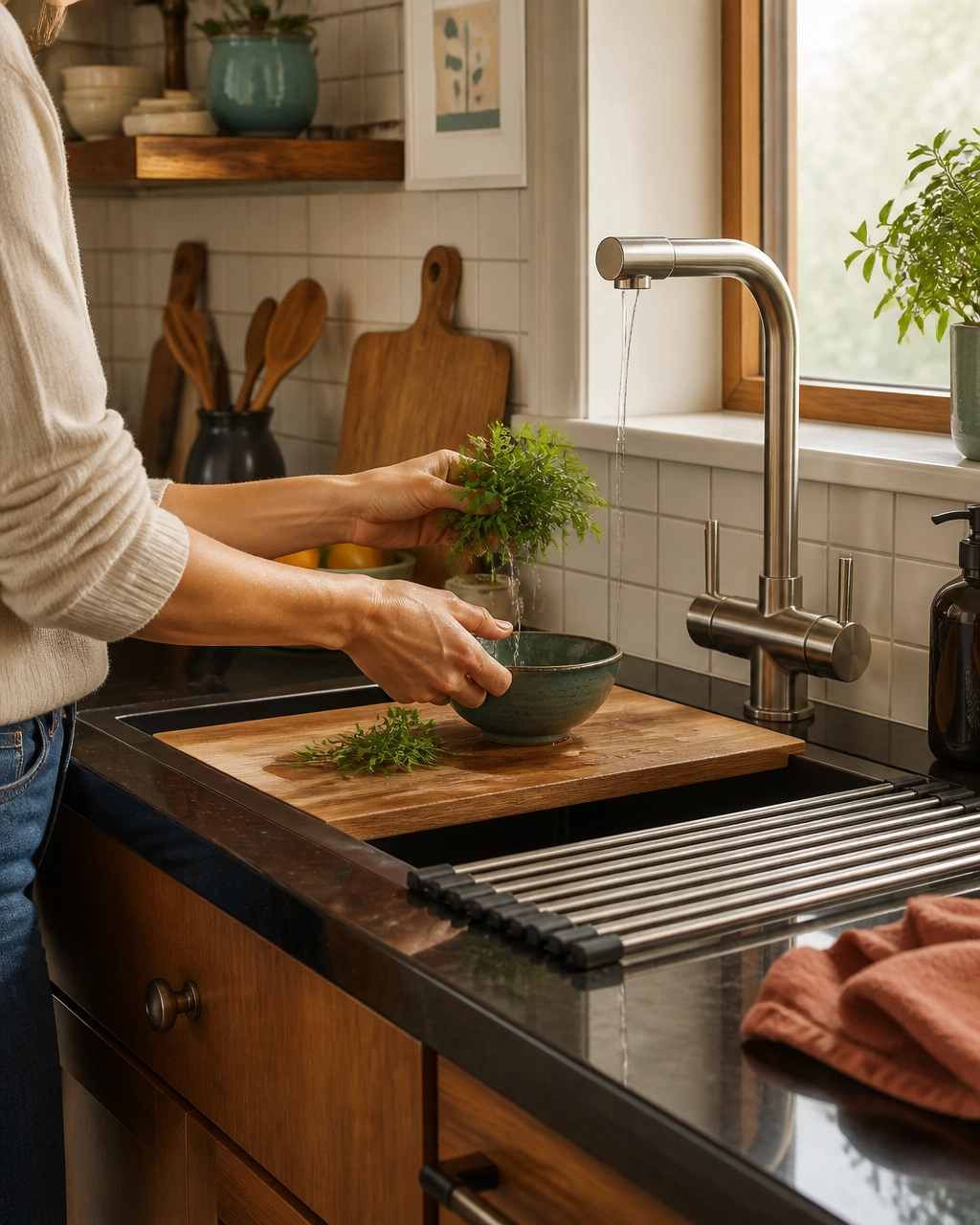
    A roll-up rack uses the space above the sink for drying dishes, rinsing produce, or resting a hot item briefly, depending on its construction and stated heat resistance. When the sink area needs to work for another task, it can roll up and move to a drawer or cabinet.

    This category makes particular sense for households that hand-wash only a few dishes at a time or need a temporary drying area rather than a full-size rack. It may also be useful for rinsing produce without setting a colander directly on the counter.

    Prioritize:

    • A length and width that match your sink
    • Sturdy, corrosion-resistant rods
    • Non-slip ends that sit securely on the counter or sink rim
    • Enough support for the dishes you typically wash
    • A design with few tight crevices and easy-to-rinse surfaces

    Do not assume every roll-up rack is suitable for hot cookware. If you want to use one as a trivet, verify the manufacturer’s heat guidance rather than treating the feature as universal. Thin rods, loose silicone ends, and racks that sag under ordinary dishes are also poor compromises.

    The tradeoff is capacity. A roll-up rack is usually better for controlled, short-term drying than for a household that washes a large load of dishes by hand.

    Skip it if: your sink is too small for a stable fit or you need more drying capacity than the rack can reasonably provide.

    3. Nesting mixing and prep bowls

    The problem they solve: Several bowl sizes consume the space of several bowl sizes.

    A well-designed nesting set gives you several useful bowl sizes for whisking, tossing, holding ingredients, serving, and sometimes storing leftovers while taking up little more cabinet space than the largest bowl. That is a straightforward form of space efficiency: the tools remain useful because they are not sacrificing the primary job of a bowl.

    Nesting bowls are especially worthwhile for people who cook from ingredients rather than relying entirely on one-pot meals. They are also useful in kitchens where cabinet shelves are shallow or where loose bowls tend to become an unstable stack.

    Look for smooth interiors, sturdy rims, and shapes that nest without requiring careful rearrangement. Stainless steel is durable and light, while glass or thick, well-made plastic may offer advantages for storage or microwave use. Choose based on your routine rather than assuming one material is best for every kitchen.

    Features that may not justify a higher price include built-in graters, elaborate lids, unusual shapes, and measurement markings you are unlikely to use. A lid is useful when it fits securely and stores neatly; a collection of loose lids can erase the space savings.

    The tradeoff is that a nested set may not include the exact size or depth you need. Some lightweight bowls also move around while mixing, while heavier materials take more effort to lift and store.

    Skip it if: you already own a compact set of bowls that stacks well and your kitchen has no recurring bowl-storage problem.

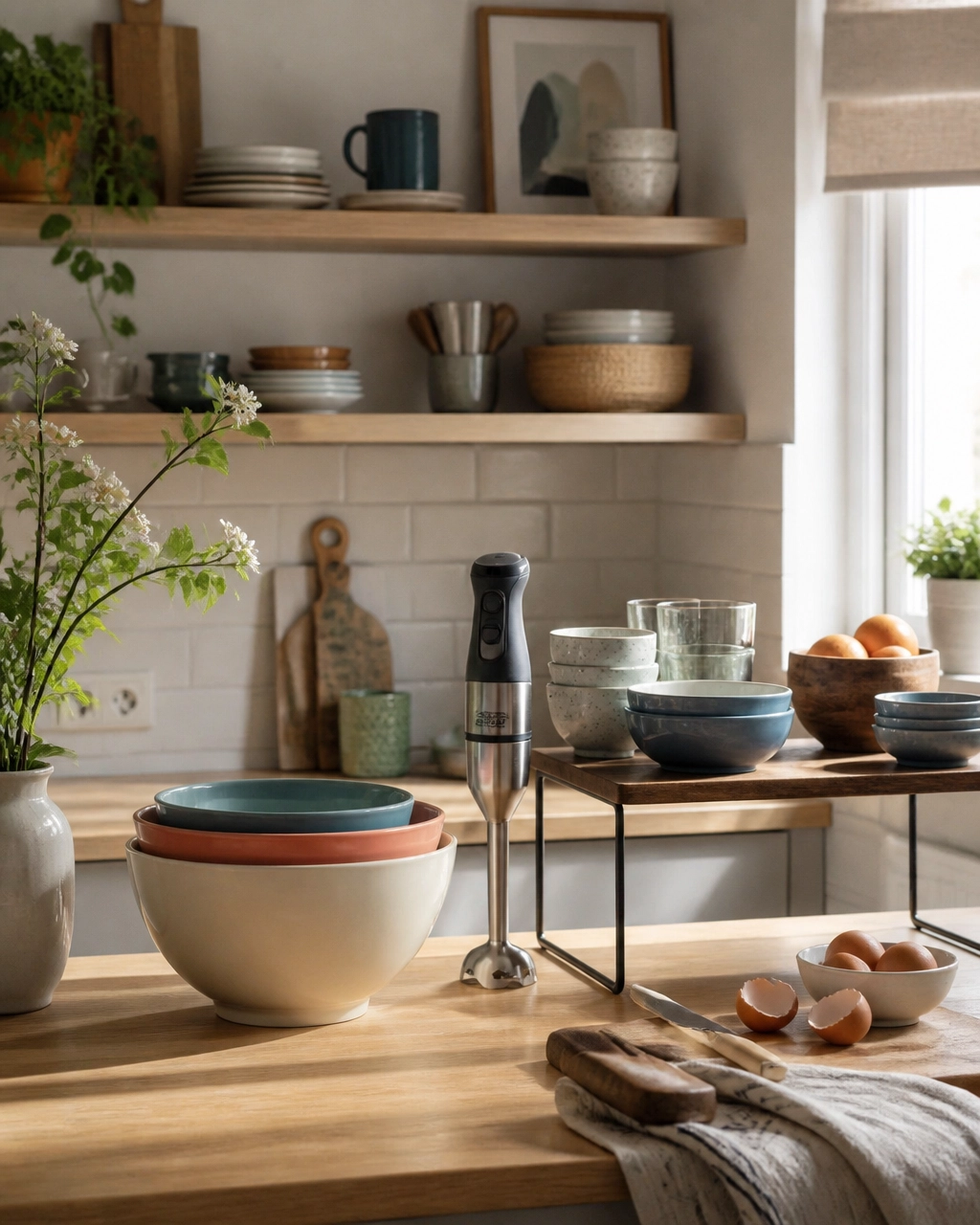
    Nesting bowls, immersion blender, and compact kitchen storage in a warm editorial setting

    4. A magnetic knife strip or other vertical knife storage

    The problem it solves: Knives take up valuable drawer space and become difficult to retrieve safely.

    Vertical knife storage can free valuable drawer space and make frequently used knives easier to identify and retrieve. A magnetic strip is one option; a wall-mounted knife block or slim in-cabinet rack may be better for renters, households with children, or anyone who prefers concealed storage.

    The important features are not decorative wood species or oversized capacity. Look for secure mounting, enough length for the knives you actually own, and a surface that holds each knife firmly without requiring forceful removal. Installation hardware matters because a storage solution is only as good as its attachment to the wall.

    Avoid paying for a strip sized for an imaginary knife collection. More capacity usually means more visual presence, not more usefulness. Also be cautious with magnetic designs that leave blades exposed in a busy walkway.

    The tradeoffs are safety, installation, and appearance. Wall-mounted storage requires drilling in many cases, and open knives may not suit every household. A strip also needs to be positioned where handles and blades will not interfere with nearby cabinets or food preparation.

    Skip it if: you rent without permission to mount it, have young children who can reach it, or already have a safe drawer insert that works well.

    5. A compact immersion blender

    The problem it solves: You want to blend soups, sauces, dressings, or small batches without storing a full-size blender.

    An immersion blender stores in a drawer or narrow cabinet and can often blend directly in a pot or tall container. That makes it useful for cooks who prepare soups, sauces, purées, or smaller portions more often than smoothies and frozen drinks.

    Choose a model with a detachable blending shaft, a comfortable grip, and food-contact parts that are straightforward to wash. A stainless-steel shaft can be a sensible durability choice. If the product includes a whisk or chopper attachment, consider whether you will use it enough to justify storing it.

    Extra speed settings, oversized accessory kits, and a storage stand are not automatically valuable. A large set can turn one compact tool into several loose pieces. The best version is one whose core function justifies the space it takes up without relying on a large collection of attachments.

    The tradeoff is capability. An immersion blender may not produce the same results as a full-size blender for large batches or very smooth frozen drinks. It can also splash if used in a shallow container.

    Skip it if: you rarely blend anything or already own a countertop blender that handles your routine without creating storage problems.

    6. A shelf riser or vertical cabinet organizer

    The problem it solves: Cabinet height is being wasted, while short stacks of dishes or pantry items become difficult to reach.

    A shelf riser creates a second level inside a cabinet. A vertical divider can do a similar job for cutting boards, baking sheets, trays, or lids. These are not exciting purchases, but they can make existing storage significantly easier to use without adding another piece of furniture.

    This category benefits people with tall cabinets, deep shelves, or a collection of flat items that currently lean in an unstable pile. It earns its place when it improves access as well as capacity. If you can remove one plate without disturbing everything around it, the organizer is doing useful work.

    Prioritize dimensions, load stability, and a surface that will not slide easily. Adjustable versions can be helpful when the cabinet may change, but adjustment mechanisms should not make the unit wobbly or difficult to clean.

    Do not pay for elaborate modular systems when a simple, correctly sized riser will solve the problem. Avoid organizers that make a cabinet technically hold more while leaving no clearance to remove anything.

    The tradeoff is that every riser also takes up some vertical and horizontal room. Poorly chosen versions can reduce flexibility rather than improve it.

    Skip it if: your cabinets are already easy to access or you have not edited out duplicate dishes and unused pantry items first.

    7. A compact toaster oven: only when it replaces something

    The problem it solves: You need small-batch baking, reheating, or toasting without relying on a full-size oven or keeping several separate appliances.

    A compact toaster oven is the one category on this list that deserves unusually strict scrutiny. It can earn its footprint when it replaces a toaster and gets frequent use for reheating, roasting, or cooking smaller portions. It may also reduce the need to heat a full-size oven for modest tasks.

    Before buying, measure the available counter depth and check the required clearance around the appliance. Then consider capacity. A model that cannot accommodate the dishes or portions you actually cook may be too limited, while a larger one may consume the space it was supposed to save.

    Useful features include removable racks and a crumb tray, controls that are easy to wipe, and a door and rack system that feel sturdy. Preset programs and digital displays are secondary. They are not worth much if the appliance is difficult to clean or awkward to store.

    The tradeoff is permanent footprint and heat. Unlike the other tools here, a toaster oven usually needs a designated counter position and cannot simply disappear into a drawer after use. It may also duplicate an oven, toaster, or air fryer.

    Skip it if: you do not expect to use a small oven frequently, cannot provide the manufacturer-required countertop clearance, or already have another appliance covering the same jobs.

    The space test for anything else

    Before bringing home another kitchen tool, ask five questions:

    1. What recurring problem does it solve?
    2. How often will I realistically use it?
    3. Does it replace or improve on something I already own?
    4. Can I clean it without adding an unwanted chore?
    5. Where will it live when the task is finished?

    A product does not earn space merely because it folds, nests, mounts, or collapses. Those features matter only when the tool still performs its main job reliably.

    The strongest small-kitchen purchases are usually quiet ones: a workstation that creates prep space, bowls that store as one, a blender that replaces a larger machine, or an organizer that makes existing cabinets easier to use. For more practical ideas, explore the Things Well Chosen Kitchen section. The goal is not to fit more into the room. It is to make room for the tools you will actually reach for.

  • Smart Home Upgrades That Actually Make Daily Life Easier

    Smart Home Upgrades That Actually Make Daily Life Easier

    The best smart-home technology does not ask for your attention all day. It quietly removes a repeated annoyance: a light left on, a thermostat that needs constant adjustment, crumbs under the table, or the nagging question of whether the back door is locked.

    That is the standard worth using. A device should make a routine easier often enough to justify the app, account, setup, maintenance, and privacy considerations that come with it. If it only adds another screen or another way to troubleshoot the house, the non-smart version may be the better choice.

    These are the upgrades most likely to earn their place in a real home—and the situations where you can comfortably skip them.

    Start with the friction you repeat most

    Smart-home technology is easiest to justify when it solves a problem that happens frequently.

    Before shopping, identify the task you perform repeatedly or the small uncertainty you carry through the day:

    • Walking through the house to turn off lights
    • Adjusting the thermostat several times a day
    • Wondering whether the garage or back door is locked
    • Cleaning pet hair and crumbs from floors
    • Checking under sinks after a washing machine cycle
    • Managing several phones, tablets, and rechargeable devices
    • Remembering to turn off a lamp, fan, or countertop appliance

    The best upgrade is not necessarily the most capable one. It is the device that removes one of these annoyances without creating three more.

    A useful rule: begin with one room, one routine, or one repeated problem. A smaller system is easier to understand, maintain, and secure.

    Smart lighting and dimmers: useful because you use them constantly

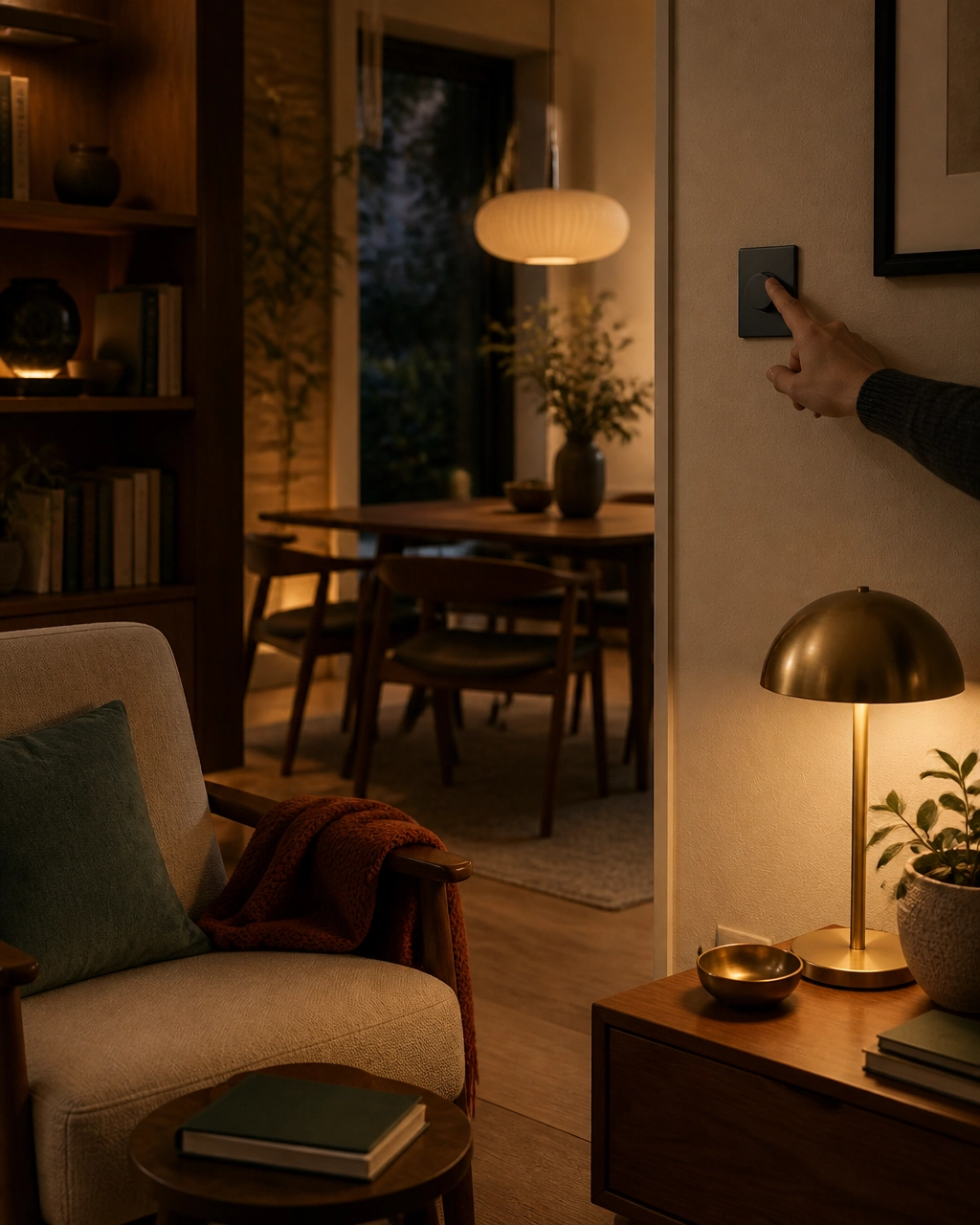
    Hand adjusting a simple wall dimmer in a warm, comfortable home

    Lighting is one of the few smart-home categories that can improve daily life in small ways from morning through bedtime. The benefit is not that a bulb connects to an app. It is that the light can respond to how the room is being used.

    A smart dimmer or smart switch can help you:

    • Turn off several lights from one location
    • Set a softer evening level without adjusting each lamp
    • Schedule porch or entry lighting
    • Turn on a hallway light at a particular time
    • Control a lamp when the physical switch is inconvenient to reach

    Who benefits most

    Smart lighting is particularly useful in rooms with several fixtures, homes where switches are poorly placed, and households with predictable morning or evening routines. It can also help anyone who finds bright overhead lighting uncomfortable later in the day.

    For whole-room control, a smart switch or dimmer is often more practical than replacing every bulb. The wall control remains familiar to guests, and the light still works in a conventional way when someone taps the switch.

    Smart bulbs make more sense when you want different color temperatures, portable lamps, or room-by-room scenes without changing electrical hardware.

    Tradeoffs to consider

    Compatibility matters. A dimmer must be appropriate for the type of bulbs and wiring in the fixture, and installation may be unsuitable for some renters or older homes. Smart bulbs can become frustrating if someone repeatedly turns off the physical switch, cutting power to the bulb and making app control unavailable.

    Look for devices that work with your preferred home platform. Matter is designed to improve interoperability across compatible smart-home ecosystems, but you should still verify that the specific device and features you want are supported by your preferred platform before buying.

    The non-smart version may be better if you only need one light to turn on and off in one predictable place. A standard dimmer, timer, or motion-sensing switch may solve the problem with less setup and no account.

    Smart plugs: small devices with a narrow but useful job

    Smart plugs are appealing because they are relatively simple solutions to several everyday problems. Their strongest use is not controlling everything remotely. It is scheduling or automating a simple device that otherwise requires repeated attention.

    Good candidates include:

    • A lamp that should turn on at dusk
    • A fan used on a regular sleep schedule
    • An entertainment setup that can be powered down overnight
    • Seasonal lighting
    • A compatible low-power device that benefits from a predictable schedule

    Choose devices that are appropriate for the electrical load, and avoid using a basic smart plug as a casual substitute for a properly rated control or safety device. Heating appliances and other high-draw equipment deserve particular caution.

    Who benefits most

    Smart plugs work well for people with predictable routines, hard-to-reach outlets, or lamps and appliances that lack built-in scheduling. They can also help create a simple “away” routine without replacing an entire lighting system.

    Their weakness is that they can multiply clutter. Five plugs from five different brands can mean five apps, inconsistent reliability, and a confusing list of devices with names no one remembers.

    The non-smart version may be better when a physical timer, power strip, or appliance setting already handles the job. If you will only use a plug once a month, the connection may not be worth managing.

    Smart thermostats: worthwhile when they match your HVAC system

    A smart thermostat can reduce repeated adjustments and help avoid heating or cooling an empty home. Remote control is useful, but the more meaningful benefit is having the system follow a schedule without requiring you to remember it every day.

    ENERGY STAR says certified smart thermostats save an average household more than 8% on heating and cooling costs, or about $50 per year, based on field data from homes in the United States. Actual results vary with climate, HVAC usage, home insulation, and how the thermostat is used. Homes with higher heating and cooling bills or long periods of vacancy may have more opportunity to save. ENERGY STAR’s smart thermostat guidance provides useful context.

    Who benefits most

    This upgrade is most compelling for households with regular schedules, large seasonal HVAC bills, vacation properties, or a tendency to heat and cool an empty home. It may also improve comfort when the existing thermostat is inconveniently located or difficult to program.

    Tradeoffs to consider

    Compatibility comes first. Some systems require a common wire, a compatible voltage, or professional installation. Heat pumps, multi-stage systems, boiler systems, and older setups may need extra care. Confirm compatibility with the HVAC manufacturer or a qualified installer rather than assuming the thermostat will work.

    Thermostats also collect information about temperature settings, occupancy patterns, and household routines. Review the manufacturer’s privacy policy and account-security options. If you do not want a device tracking your schedule, a well-programmed conventional thermostat may be a more comfortable choice.

    A smart thermostat is not automatically an improvement if you constantly override it. In that case, a reliable programmable model may provide similar scheduling with less data collection and fewer points of failure.

    Smart locks: convenient, but not a casual purchase

    Smart locks solve a specific collection of small problems: misplaced keys, temporary access for visitors, and uncertainty about whether the door was locked.

    Useful functions may include:

    • Temporary codes for houseguests or service providers
    • A notification when the lock is operated
    • Remote confirmation that the door is locked
    • A scheduled locking routine at night
    • Keyless entry when your hands are full

    Who benefits most

    Smart locks can be helpful for households with frequent visitors, caregivers, dog walkers, short-term guests, or family members who need access at different times. They can also be useful when the existing lock is awkward to operate.

    The tradeoffs are more serious than they are with a smart lamp. The lock needs reliable power, the hardware must fit your door, and the app or account must be secured. Keep a physical key or another backup entry method, and monitor battery warnings rather than treating them as optional notifications.

    Entry logs are sensitive household information. Use a strong, unique account password and two-factor authentication when available. Understand who can create codes, view activity, and unlock the door remotely.

    A standard deadbolt is likely better if you rarely share access, prefer a simple mechanical solution, or are uncomfortable placing entry control in an app. Convenience is valuable here, but reliability should be the deciding factor.

    Video doorbells and cameras: useful only with clear boundaries

    A video doorbell can answer a practical question without requiring you to open the door: Who is there, and is the delivery at the right address? It may also help you notice visitors while you are away.

    That does not mean every home needs cameras throughout the property. More coverage creates more notifications, more footage to manage, and more privacy considerations.

    Before buying, investigate:

    • Whether video history requires a subscription
    • Whether local storage is available
    • How long footage is retained
    • Whether audio can be disabled
    • How motion zones and privacy masks work
    • Whether multiple household members can have separate access
    • What happens if the internet connection is unavailable

    Cameras and microphones deserve more scrutiny than lights or leak sensors. The Federal Trade Commission recommends changing default passwords, installing updates, securing the home network, and using account protections such as two-factor authentication for internet-connected devices. The FTC’s home-device security guidance is a useful starting point.

    When to skip them

    Skip a camera if you do not want to maintain recordings, tune alerts, or evaluate where the lens and microphone point. A doorbell with no recording plan may still provide a live view, but understand what functionality remains without a subscription. A conventional peephole, door viewer, or motion light may be enough for a home that does not need remote video.

    Robot vacuums: a meaningful labor-saving upgrade for the right floor plan

    Robot vacuum cleaning beneath a sofa in a warm living room with a Goldendoodle nearby

    A robot vacuum does not replace every kind of cleaning. Its value is more specific: it can handle repeated, lower-level floor maintenance so dust, crumbs, and pet hair do not accumulate as quickly between deeper cleanings.

    Who benefits most

    This category is most useful in homes with mostly open floor areas, hard flooring, low-pile rugs, pets, children, or anyone who finds frequent sweeping difficult to keep up with. Scheduled cleaning can be helpful because it reduces the need to remember the task.

    Tradeoffs to consider

    Robot vacuums need a reasonably clear path. Cords, small toys, clothing, and clutter can interrupt a cleaning run. The device also needs maintenance: emptying the bin, cleaning brushes, replacing filters, and dealing with occasional mapping or navigation issues.

    Some models use cameras or detailed sensors to navigate and map rooms. A home map can reveal the layout of your living space, so privacy should be part of the decision. Review whether maps are stored in the cloud, whether local control is available, and which features require an ongoing subscription.

    The non-smart version may be better for a small apartment, a crowded floor plan, or a home where vacuuming is already easy to do manually. A robot that spends more time being rescued than cleaning is not reducing friction.

    Leak sensors: a quiet upgrade with a clear purpose

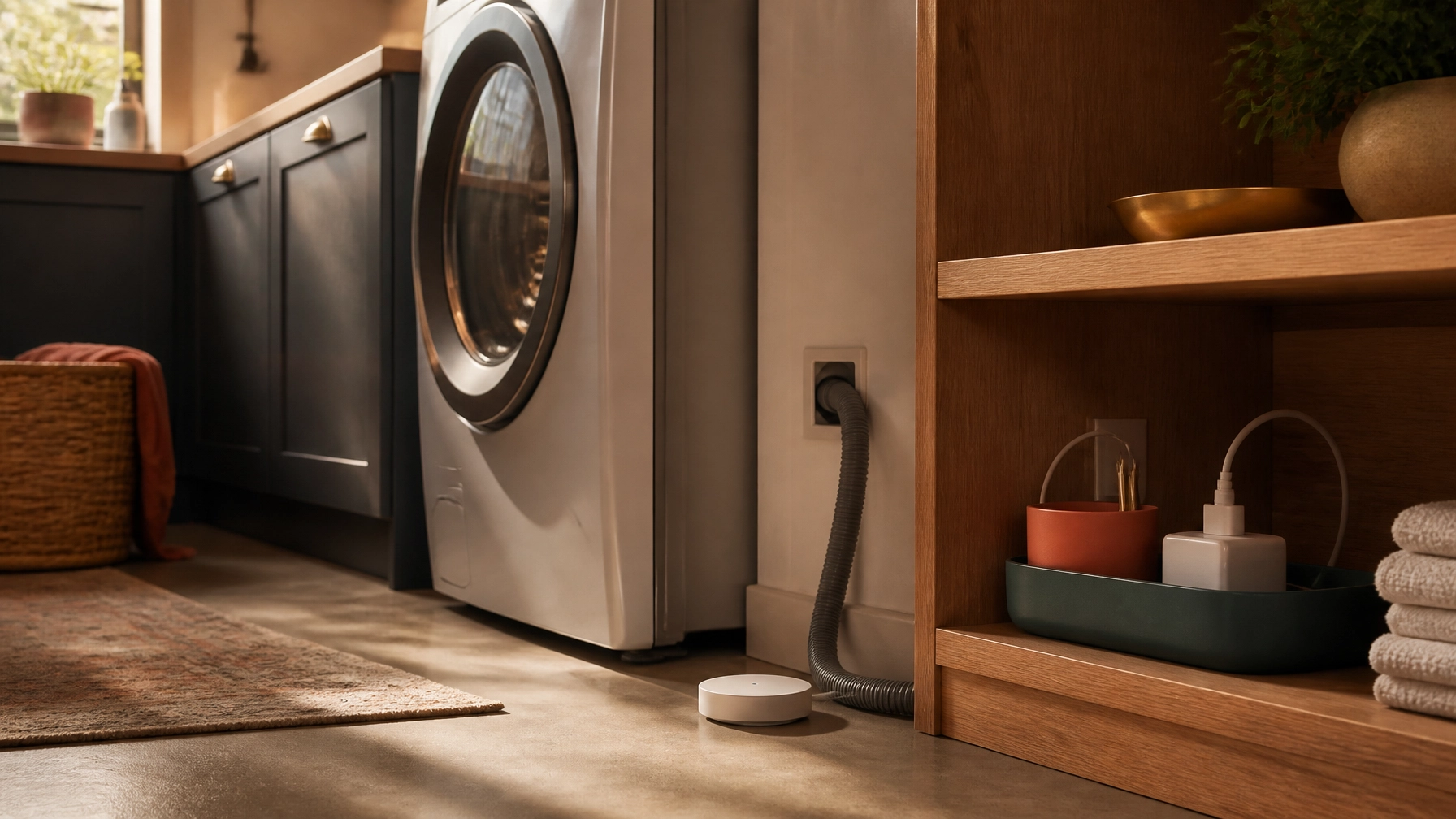
    Discreet water leak sensor beside a washing machine hose and tidy charging area

    Leak sensors are not entertaining, but they solve a problem where early notice can matter. Place them near a water heater, washing machine, dishwasher, under-sink plumbing, or other area where a small leak could go unnoticed.

    They can send an alert when moisture is detected. More involved systems may connect to an automatic shutoff valve, but whole-home shutoff equipment generally requires careful installation and should not be treated as a casual plug-in purchase.

    Who benefits most

    These sensors are especially sensible for homeowners, people who travel, households with laundry equipment on upper floors, and anyone with plumbing areas that are difficult to inspect regularly.

    Maintenance is modest but real. Test the sensors occasionally, replace batteries as needed, and make sure alerts reach someone who can respond. A sensor that is buried behind stored items or paired with an ignored notification is not doing much.

    Privacy risk is generally lower than with cameras or microphones, though connected devices still use accounts and may transmit data to a vendor’s service. Read the basic data and outage details before buying.

    If you check vulnerable areas often and would not act on remote notifications, a visual water alarm may be enough. The smart version is most useful when you may be away from home when a problem begins.

    Routines and charging systems: automate the routine, not the entire house

    Automation works best when it is simple, predictable, and easy to undo.

    A useful routine might turn off downstairs lights and lock the door at bedtime, lower the thermostat when the home is empty, or switch on a lamp before you arrive. Start with one trigger and one or two actions. If a routine contains too many conditions, it becomes difficult to understand when something does not happen as expected.

    Device management can benefit from the same restraint. A dedicated charging area with labeled cables and one place for phones, tablets, headphones, and portable devices may improve daily life more than a complicated charging automation. A smart plug can schedule a particular charger or lamp, but many modern devices already manage charging internally. Do not buy a connected charger simply because it offers an app.

    Voice assistants are worth considering only where hands-free control genuinely helps: setting a kitchen timer, turning off lights while carrying laundry, or adding an item to a shopping list. They are less useful when the same task is just as easy from a nearby switch.

    Because voice assistants rely on microphones and may send or store voice recordings, review the device’s recording controls, physical mute options, retention settings, and account permissions. A physical timer, switch, or written list may be preferable for households that would rather not keep an always-available microphone in the room.

    Choose a simple system before choosing more devices

    A smart home becomes easier to live with when it has a clear center of gravity.

    Pick one primary platform that works for the people in your household, then check whether new devices support it. Matter can reduce some cross-brand compatibility problems, but product-specific limitations still exist. Confirm the features you need rather than relying on a logo on the box.

    Also look for:

    • Core functions that work without a subscription
    • Local control or local storage where practical
    • Clear software-update policies
    • Strong account security and two-factor authentication
    • Manual controls when the app, Wi-Fi, or cloud service is unavailable
    • A realistic plan for batteries, filters, and device replacement

    The most reliable setup may include fewer devices than you expected. A smart thermostat, a few well-placed lights, one useful cleaning device, or leak protection may be enough.

    The practical starting point

    If you want to begin carefully, choose the category connected to your most repeated annoyance:

    • Forgotten lights: Start with a smart switch, dimmer, or one smart plug.
    • Thermostat adjustments: Check HVAC compatibility before considering a smart thermostat.
    • Daily floor maintenance: Consider a robot vacuum only if the floors are reasonably clear.
    • Shared access: Look at a smart lock with strong backup entry options.
    • Travel or plumbing concerns: Start with leak sensors in the highest-risk locations.
    • Too many devices: Improve charging and cable management before adding more automation.

    A smart home should feel calmer, not more demanding. The right upgrade performs a small useful job repeatedly, gives you a straightforward manual fallback, and does not require constant supervision. Everything else can wait.

    Explore the Things Well Chosen Tech & Automation section for more useful electronics, smart-home ideas, and practical ways to make everyday routines easier.

  • The Small Home Upgrades Worth Making

    The Small Home Upgrades Worth Making

    The best small home upgrades are not always the most dramatic ones. They are the changes that remove a repeated annoyance, improve comfort, or help a room work better every day.

    That might mean adding light where you actually prepare food, giving keys and shoes a reliable landing place, or replacing a bathroom fan you avoid turning on because it is noisy and ineffective. The improvement may be easy to overlook, but you notice it each time you use the room.

    This is the standard worth applying before spending money: What problem does this solve, and will I still appreciate the solution a year from now?

    Here are the upgrades most likely to earn their cost, effort, or space in a normal home.

    1. Add lighting where the work happens

    A single overhead fixture rarely does everything a room needs. It may provide enough general illumination while leaving a kitchen counter, reading chair, desk, or bathroom mirror in shadow.

    Layered lighting is often a more meaningful improvement than replacing one decorative fixture. Think in terms of:

    • Ambient light for general visibility
    • Task light for cooking, reading, grooming, or working
    • Accent light for warmth and visual balance

    You do not need to rewire the entire room. A well-placed table lamp, floor lamp, plug-in sconce, or under-cabinet light can address the specific area that feels difficult to use.

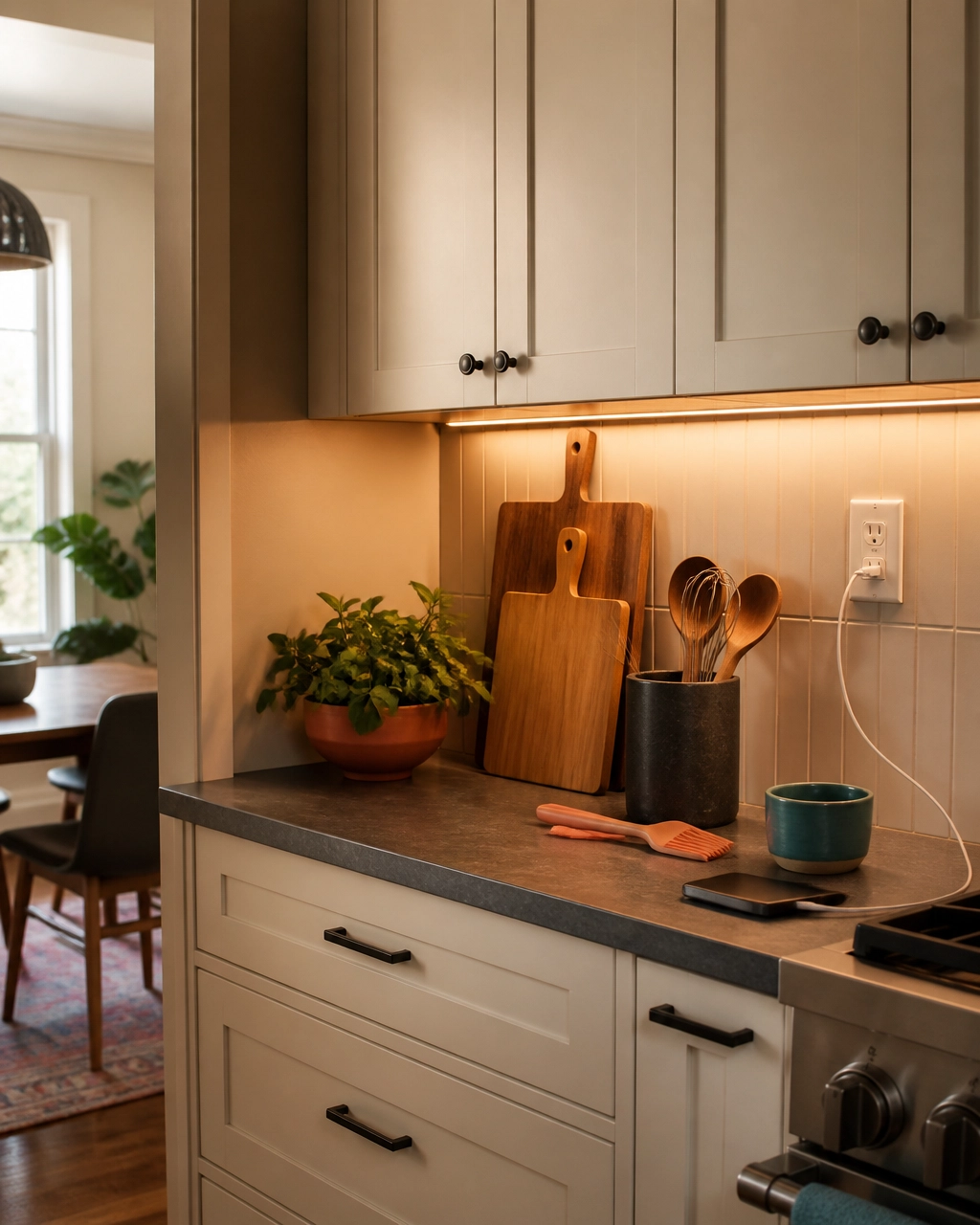
    Warm kitchen work zone with practical under-cabinet lighting and useful counter space

    Who benefits most

    This is especially worthwhile in kitchens with shadowy counters, living rooms with one central ceiling fixture, bedrooms without bedside lighting, and home offices where overhead light creates glare.

    Renters and anyone avoiding electrical work can look for plug-in, rechargeable, or battery-operated options. Homeowners may also find that a simple lighting change solves the problem without the expense of adding new wiring.

    What makes it worth doing

    The upgrade earns its place when it improves a repeated activity. Better visibility can make food preparation, reading, cleaning, or getting ready in the morning less tiring. Dimmers can also make a room more adaptable: brighter when you need to see clearly, softer when you are settling in for the evening.

    Warmer light often feels more relaxed in living spaces and bedrooms, while kitchens and bathrooms may benefit from a crisper light where tasks require it. More important than choosing one color temperature everywhere is avoiding an accidental mix of noticeably different whites within the same room.

    Common mistakes and tradeoffs

    Adding lamps without considering cords, switch access, or walking paths can create a new annoyance. Under-cabinet lights should illuminate the counter rather than shine directly into your eyes. A decorative lamp is not automatically useful if it leaves the chair or surface you use most in darkness.

    Dimmers and replacement switches also require compatibility checks. Some fixtures and bulbs are not designed to work together, and electrical changes may be better handled by a qualified professional if you are not comfortable with the work.

    This upgrade is probably not worth prioritizing if the room already has adequate, well-placed light or if the real issue is a blocked window, dark paint, or furniture arranged in the wrong place.

    2. Improve switches, outlets, and charging access

    A home can look finished and still be inconvenient to use. The evidence is usually found in the extension cords, crowded power strips, and phones charging on the floor.

    Improving electrical access can be a practical upgrade when it is based on how the room is actually used. A dimmer in a living room or bedroom may provide more value than a new ceiling fixture. An outlet with charging access near a desk or entryway may reduce daily clutter. A switch placed in a more intuitive location can make a room easier to navigate.

    Who benefits most

    Consider this category if you regularly use extension cords, unplug one appliance to use another, charge devices in awkward places, or rely on a lamp that is difficult to reach.

    It can be particularly helpful in older homes, rooms that have changed purpose over time, and homes where furniture placement no longer matches the location of the outlets.

    What makes it worth doing

    The useful question is not whether a newer outlet looks more modern. It is whether the change makes a repeated routine safer or easier.

    Before making changes, observe the room for a few days. Where do devices naturally get charged? Which lamp do you wish you could dim? Which outlet is hidden behind furniture? That information is more valuable than installing upgrades everywhere at once.

    Common mistakes and tradeoffs

    Do not assume every outlet or switch is a straightforward DIY replacement. Existing wiring, box depth, circuit requirements, and local codes can affect what is appropriate. Smart controls can add convenience, but they may require a reliable connection, app management, or a compatible system. More features are not necessarily better if the basic switch is already easy to use.

    When an electrical change involves new wiring, unfamiliar components, or a safety concern, bring in an appropriately qualified electrician. The upgrade is not worth compromising safety to complete quickly.

    3. Create a real entryway drop zone

    Many homes do not have a formal entryway. They still need one.

    Without a defined landing place, keys, mail, shoes, bags, and outerwear spread across the nearest available surfaces. A narrow wall, a small corner, or the space behind a door can often become a functional drop zone with less furniture than people expect.

    A useful setup may include:

    • A few sturdy hooks at a practical height
    • A shallow shelf or ledge
    • A tray for keys and small items
    • A low shoe rack or washable mat
    • A small bench if the space allows
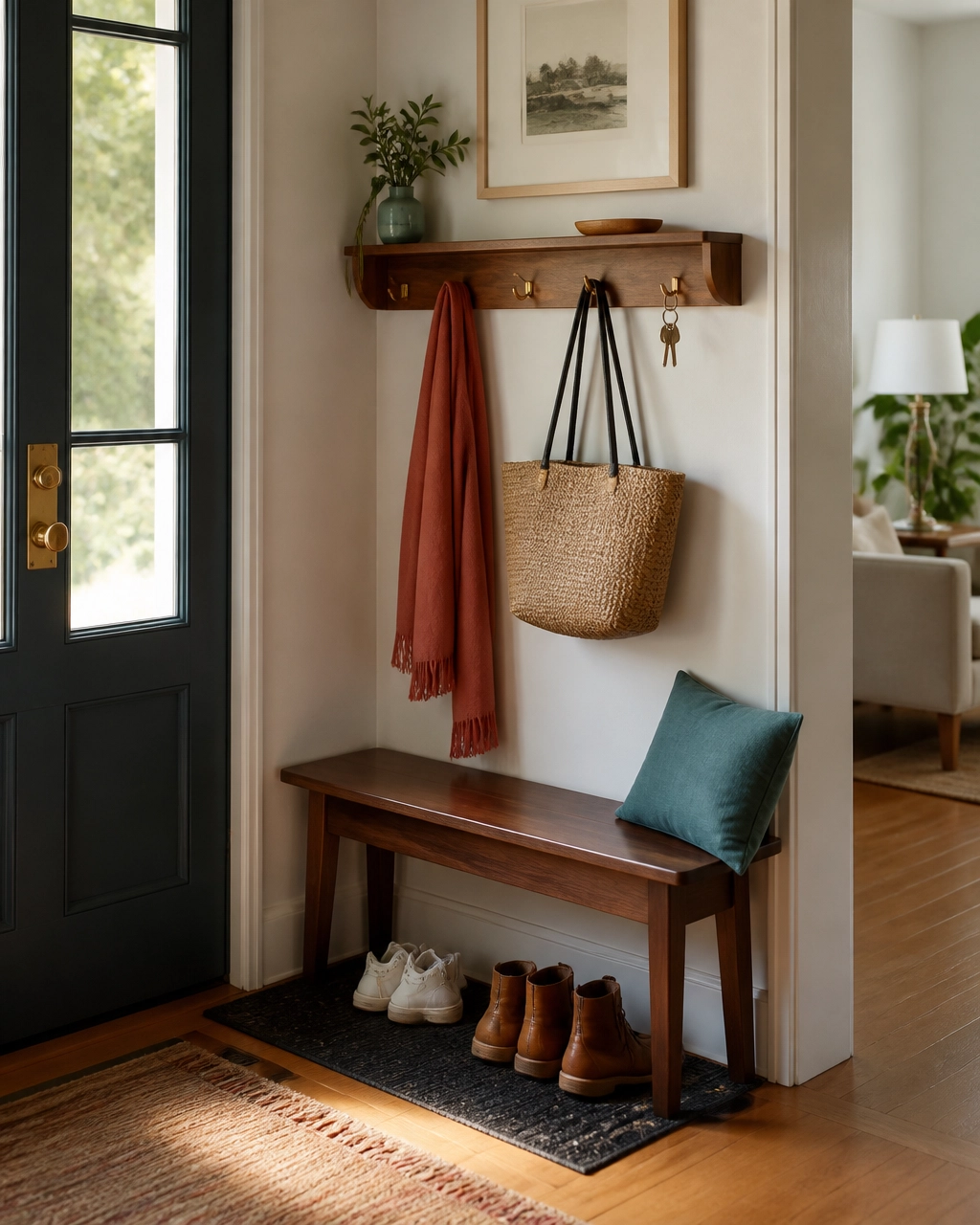
    Compact entryway with a walnut bench, wall hooks, key tray, and restrained shoe storage

    Who benefits most

    This upgrade is most useful for households where clutter collects near the door, where people enter through a narrow hallway, or where shoes and bags tend to migrate from room to room.

    It can also help renters because many versions are removable or require only limited installation. A row of hooks and a slim shelf may be enough; a full bench is optional.

    What makes it worth doing

    The value comes from reducing decisions. When the key tray, bag hook, and shoe location are obvious, the room is easier to reset. A drop zone can also protect floors by giving wet or dirty shoes a contained place to land.

    The right arrangement depends on the people using it. Hooks placed too high for children will not solve the household’s actual problem. A beautiful shelf that is too narrow for the items being dropped there will become a decorative obstacle rather than useful storage.

    Common mistakes and tradeoffs

    Do not create a drop zone larger than the problem requires. A large cabinet can consume valuable circulation space, especially in a small hallway. Open hooks are convenient, but they can look crowded when every coat and bag is left out. Closed storage offers a calmer appearance but requires more effort to put things away.

    This upgrade is probably not worth the money if the entryway is already functional and the clutter is really coming from having too many coats, shoes, or bags. Edit the volume first. Storage cannot correct an excess problem indefinitely.

    4. Upgrade window treatments for privacy, light, and proportion

    Window treatments earn attention when they solve a practical issue as well as improving the room’s appearance.

    The right shade or curtain can reduce glare, improve privacy, soften harsh daylight, and make a room feel more settled. In bedrooms, room-darkening layers may support better rest. In home offices, light-filtering treatments can make screens easier to use. In bathrooms, privacy matters more than decorative effect.

    Who benefits most

    This is worth considering if curtains stop short of the floor, rods are too narrow for the window, rooms feel exposed at night, or sunlight makes certain spaces uncomfortable during the day.

    It can also help rooms with awkward proportions. Curtains mounted thoughtfully can give a short window more presence or make a low-ceilinged room feel visually taller.

    What makes it worth doing

    Prioritize the function of the room. A lined curtain or layered shade may be more useful than a thin decorative panel. In a bedroom, light control matters. In a living room, privacy and softness may matter more. In a bathroom, select materials and mounting methods suited to moisture.

    One carefully chosen treatment in the room that causes the most trouble may be enough. There is no need to replace every treatment at once.

    Common mistakes and tradeoffs

    Oversized or poorly supported rods can sag. Curtains that are too short can make a room feel unfinished, while excessively long fabric may collect dust and become a tripping concern. Pattern and color also deserve restraint; a window treatment should support the room rather than dominate it.

    Do not buy treatments before measuring the window, wall, mounting area, and clearance around nearby furniture. An inexpensive panel that does not fit the space is not a value.

    5. Make storage easier to reach, not simply larger

    Storage improvements are worthwhile when they improve access. Adding more shelves, bins, or furniture without addressing how things are retrieved can make a room feel more crowded and no more functional.

    Start with a problem area: a deep cabinet, a chaotic closet, a narrow bathroom, or an entryway with no place for small items. Then choose the lightest solution that makes the contents visible and reachable.

    Useful categories can include:

    • Adjustable shelf risers
    • Vertical dividers for trays and boards
    • Wall-mounted shelves or peg rails
    • Pull-out organizers for deep cabinets
    • Narrow baskets for grouped items
    • Hooks on the backs of doors

    Who benefits most

    This is particularly valuable in small homes, rentals with limited built-ins, and rooms where everyday items disappear into deep or poorly divided storage.

    What makes it worth doing

    A storage upgrade earns its space when it saves time repeatedly and remains easy to maintain. The best systems do not require elaborate rules. They make it clear where an item belongs and leave enough room to remove one thing without disturbing everything around it.

    Measure first. Check shelf depth, door clearance, wall construction, and the size of the items being stored.

    Common mistakes and tradeoffs

    Bins can hide clutter as easily as they contain it. Open shelving makes frequently used items accessible but requires a level of visual order. Freestanding furniture may add capacity while reducing floor space and making a walkway less comfortable.

    If the area contains things you no longer use, decluttering is the upgrade. New storage is unlikely to justify itself when it is only creating a better container for unused belongings.

    6. Improve the bathroom’s light, ventilation, and small points of contact

    A bathroom does not need a full renovation to feel more comfortable and usable. Small functional changes can matter more than new finishes.

    Better vanity lighting can improve grooming and reduce shadows. A sturdier towel hook can keep linens off the floor. A timer or humidity-sensing control may make it easier to run an exhaust fan long enough after a shower. Replacing a tired showerhead or adding a simple shelf may also help if the existing setup is inconvenient.

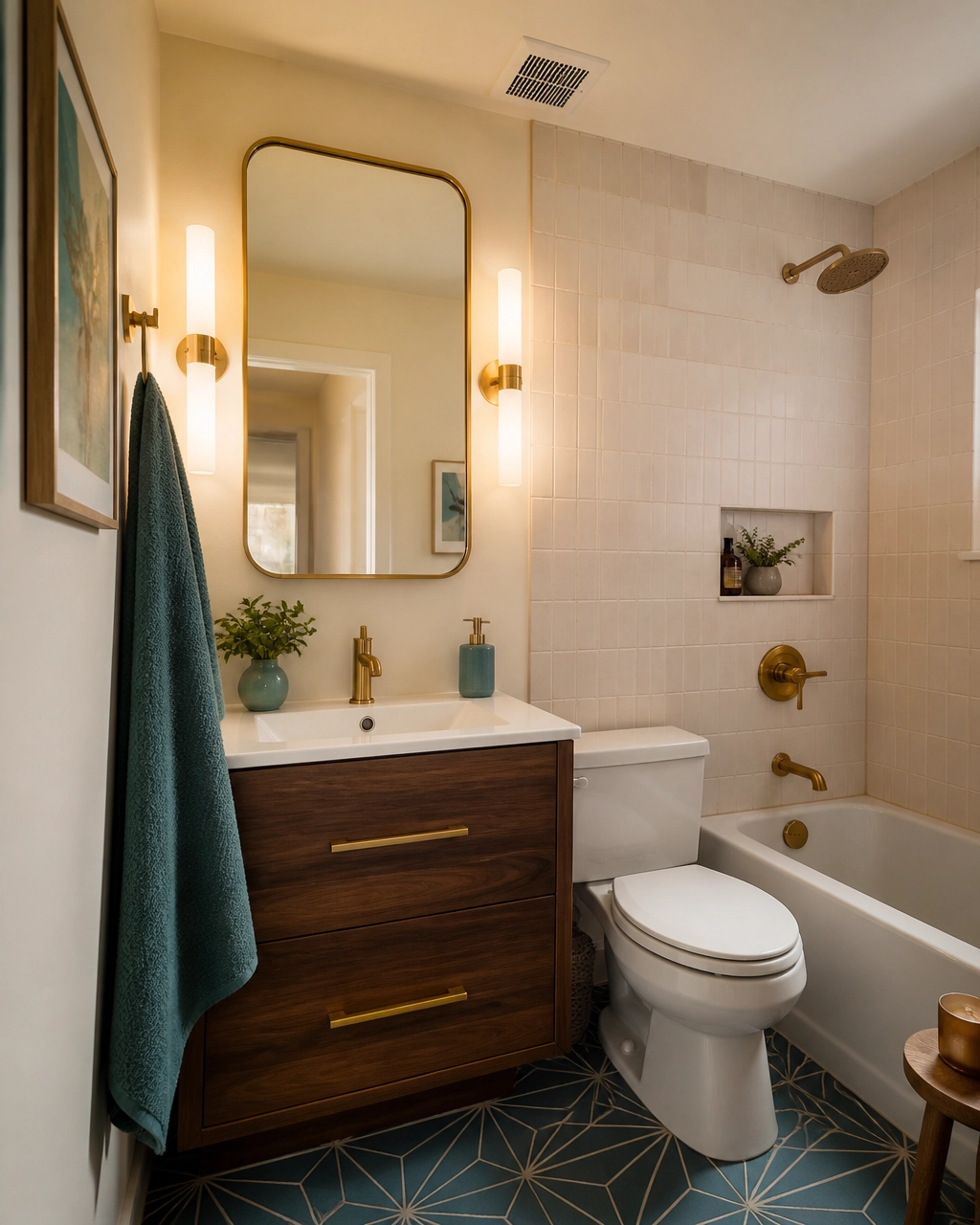
    Calm small bathroom with useful vanity lighting, durable hardware, and discreet ventilation

    Who benefits most

    Look here if the mirror area is poorly lit, towels never have a practical place to dry, the bathroom stays humid for too long, or shower products collect on the floor or edge of the tub.

    What makes it worth doing

    Ventilation is a comfort and maintenance issue, not just an aesthetic one. If a bathroom remains damp, start with basic maintenance: clean the fan grille and make sure the fan is operating as intended. If performance is still poor, have the system evaluated before assuming that replacing the fan alone will solve the problem.

    A small shelf or hook is worthwhile when it keeps frequently used items off wet surfaces. A light fixture is worthwhile when it improves visibility without producing harsh glare.

    Common mistakes and tradeoffs

    Do not choose bathroom accessories only for appearance. Materials, mounting strength, moisture exposure, and cleaning needs matter. Adhesive products may be convenient, but they are not suitable for every surface or load. A shelf that makes the shower feel crowded may be less useful than a simple hook outside it.

    A bathroom upgrade is probably not worth doing if it adds another surface to clean or solves a problem that could be addressed by moving existing items.

    A better way to choose your next upgrade

    Walk through your home and note the small frustrations that repeat:

    • A work surface that is always too dark
    • A door area that collects clutter
    • An outlet in the wrong place
    • A cabinet that wastes depth
    • A window that creates glare or privacy problems
    • A bathroom that stays damp or lacks useful storage

    Choose one problem, measure the space, and look for the least complicated solution. If the improvement makes a frequent task easier without adding significant maintenance, it is likely worth evaluating.

    For more practical ideas for real homes, explore the Things Well Chosen House & Home section. The same editorial test applies throughout: a home upgrade should earn its place by being useful, durable, comfortable, or quietly pleasing to live with—not merely different.

  • Pet-Friendly Finds That Don’t Look Like Pet Gear

    Pet-Friendly Finds That Don’t Look Like Pet Gear

    Living with pets does not mean surrendering the look or function of your home. But the best pet-friendly choices begin with the animal: not with whether a bed matches the sofa or a feeding station photographs well.

    A comfortable bed that supports a dog’s body, a stable bowl that is easy to clean, or a scratching surface a cat will actually use is worth considering. If it also fits naturally into the room, that is a welcome benefit. The goal is not to disguise every sign of pet ownership. It is to choose pet essentials thoughtfully enough that they feel like part of the home rather than clutter added afterward.

    Here are the categories where a little more judgment can make the biggest difference.

    Start with a pet zone, not a pile of pet things

    Pet gear tends to spread when every item is assigned a different, improvised location. A leash lands on the entry table, toys collect under the sofa, food bags occupy a corner of the kitchen, and grooming supplies migrate from room to room.

    A better approach is to create one or two practical pet zones. An entryway, mudroom, laundry area, or quiet kitchen corner can hold the essentials that support daily routines. The sleeping area may belong in the living room or bedroom, where the pet naturally wants to be.

    The most useful zones usually include:

    • A comfortable resting place
    • Food and water in a calm, accessible location
    • A basket or cabinet for toys and walking gear
    • A washable mat or throw near high-traffic areas
    • Closed storage for food, treats, grooming supplies, and medications

    This is less about creating a dedicated pet room than about reducing visual and practical friction. Store things near where they are used, but do not place bowls or beds in a busy path simply because that is where there happens to be space.

    For more ideas on keeping everyday items contained, the Things Well Chosen Organization section is a useful place to continue.

    Choose a pet bed for comfort first

    A pet bed is one of the easiest pieces to make part of a room, but appearance should remain secondary to support, size, and cleanability.

    Dogs need enough room to lie in their preferred position without hanging over the edge. Older dogs or pets with joint concerns may benefit from a bed that is easier to step onto and offers more substantial support. A very soft, shapeless cushion can look appealing but may flatten quickly or provide little structure.

    Look for:

    • A size that accommodates the pet’s full resting position
    • A supportive interior rather than decorative fluff alone
    • A removable, washable cover
    • A surface that does not trap excessive heat for the individual animal
    • A stable base that will not slide across the floor
    • Materials suited to the pet’s habits, coat, and age

    A bed in a tightly woven fabric can sit comfortably beside a sofa or reading chair without becoming a visual interruption. Muted neutrals, earthy tones, or colors already present elsewhere in the room can help it feel more settled within the space, but color coordination is never a reason to choose a bed that is too small, difficult to wash, or poorly supported.

    A Cavalier King Charles Spaniel resting in a comfortable neutral pet bed beside a warm, modern sofa

    Placement matters as much as the bed itself. Many dogs prefer to rest near their people, but not in the middle of foot traffic. Avoid drafty areas, door swings, and spots where the bed will be repeatedly kicked or moved. If a pet has trouble getting up or down, a low, stable design is generally more practical than a raised frame chosen for its furniture-like appearance.

    A built-in nook can be attractive, particularly beneath a bench or inside a mudroom cabinet, but it should not be so enclosed that ventilation, visibility, or access become concerns. A pet should be able to enter and leave comfortably, and the space should be easy to clean thoroughly.

    Make feeding stations easy to live with

    Feeding supplies are used every day, which makes them a good candidate for a more deliberate setup. They do not need to be hidden completely; they simply need a stable home.

    The most useful feeding stations share a few qualities:

    • Bowls that are stable and easy to wash
    • A water-resistant or wipeable surface beneath them
    • Enough room for the pet to eat without crowding a wall or appliance
    • Nearby storage for food, treats, and supplements
    • Placement away from the busiest paths through the room

    A simple ceramic or stainless-steel bowl can look more settled than a collection of mismatched plastic containers, but material and cleaning requirements come first. A beautiful bowl that chips easily, slides across the floor, or is difficult to sanitize is not a better choice.

    A pull-out drawer or closed cabinet for food can keep bags and scoops out of sight, but avoid storing food where heat, moisture, or pests may be a problem. Sealed containers are often more useful than oversized decorative bins, especially when they make it easier to keep food fresh and measure portions consistently.

    Raised feeding stations may be appropriate in some situations, but height should never be chosen for appearance alone. A pet’s size, eating habits, comfort, and veterinary guidance matter more than how integrated the setup looks.

    Use attractive storage for the things that actually accumulate

    Leashes, harnesses, waste bags, brushes, towels, toys, and treats are small enough to create clutter quickly. They are also used often enough that completely hidden storage can become inconvenient.

    A modest cabinet, lidded basket, or drawer near the entry can contain most walking gear. Hooks inside a closet door or on the side of a console can keep leashes accessible without making them the first thing visible when someone enters the room.

    For toys, an open basket can work well if it is sturdy, easy to lift, and large enough to hold the toys without overflowing. Choose one with a stable base and no loose loops or fragile trim that could become a chewing hazard. A basket is not automatically safer simply because it is made from natural material; inspect the construction and watch how the pet interacts with it.

    Closed storage is better for:

    • Food and treats
    • Medications and supplements
    • Grooming tools
    • Cleaning products
    • Waste bags and spare supplies

    The most successful storage does not pretend pet ownership is invisible. It makes the daily evidence of it easy to manage.

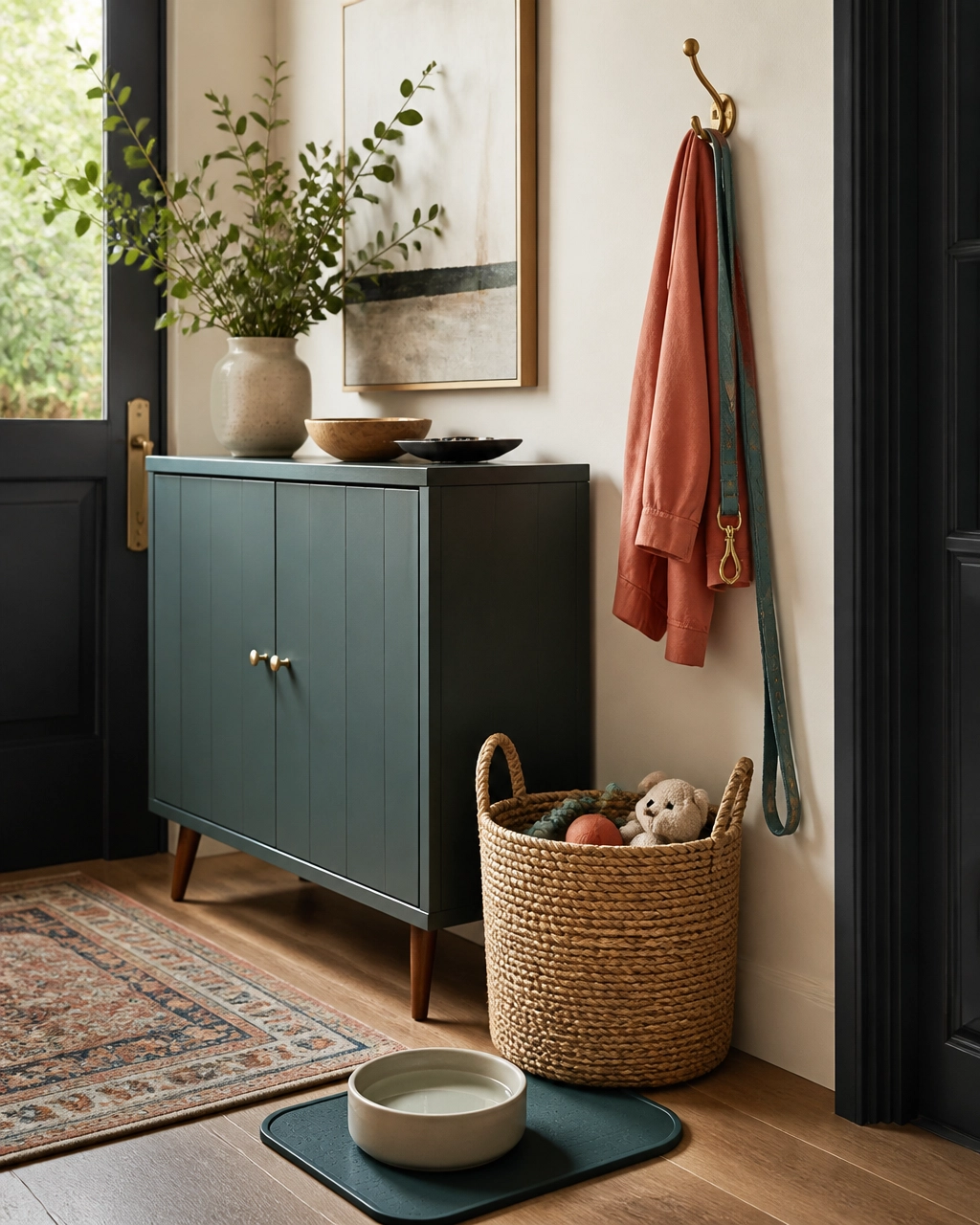
    A warm entryway with a closed cabinet, woven basket, leash storage, and a pet water bowl arranged for everyday use

    Consider crates and gates as part of the room

    Crates and gates serve important purposes, from training and rest to managing visitors, stairs, and areas that are not safe for an animal.

    A furniture-style crate can work when it provides adequate ventilation, secure construction, and enough room for the dog to stand, turn, and rest comfortably. It should not be treated as a decorative side table first and a containment space second. Avoid designs with unstable doors, narrow openings, poor airflow, or finishes that are difficult to clean.

    Similarly, a wooden or architectural-looking gate may blend into a room more gracefully than a brightly colored plastic barrier. But it still needs to latch securely, resist tipping, and suit the size and behavior of the pet. A gate that looks discreet but is easily pushed aside offers little practical value.

    When selecting a crate or gate, consider:

    • Whether the pet already feels comfortable using it
    • How easily the surface can be cleaned
    • Whether the construction can withstand scratching or chewing
    • Whether it blocks necessary airflow or visibility
    • Whether it can be removed or relocated as the pet’s needs change

    A discreet containment solution is worthwhile when it improves safety without compromising the animal’s comfort or the product’s basic purpose.

    Give cats vertical space and a real scratching surface

    Cat furniture is often the most visually conspicuous pet gear in a home. It is also an area where design-conscious choices can easily become too cosmetic.

    Cats need opportunities to scratch, climb, observe, hide, and rest. A sculptural scratching post that does not offer a satisfying scratching surface is less useful than a simple, well-built one that a cat chooses repeatedly.

    Wall-mounted shelves, window perches, and compact climbing routes can integrate more naturally than a large tower, particularly when they use a restrained palette and follow the lines of the room. But wall-mounted furniture must be securely installed, and the surrounding area should allow a cat to move between surfaces without awkward gaps or unsafe jumps.

    A content cat using a compact scratching post beneath an integrated wall-mounted shelf in a warm, modern living room

    For scratching furniture, pay attention to:

    • The material and texture the cat prefers
    • A base that will not wobble during use
    • Enough height for a full stretch
    • Replaceable or renewable scratching surfaces where possible
    • Placement near furniture the cat is already tempted to scratch

    If a cat repeatedly ignores an attractive piece, the problem may be location rather than appearance. Moving it near a favored resting spot or an existing scratching area may matter more than changing the color.

    Litter boxes deserve the same practical discipline. A ventilated enclosure can reduce visual clutter, but it should not be cramped, difficult to access, or placed near food preparation. Easy cleaning and adequate ventilation are more important than making the box disappear entirely.

    Protect furniture with washable, intentional layers

    Throws, mats, and rugs can help protect a home without making it feel covered in protective equipment. The key is to use them selectively, where they solve a predictable problem.

    A washable throw over the section of sofa a dog consistently chooses is more practical than draping every piece of upholstery. A low-pile runner near an entry can catch dirt and moisture before it travels through the house. A washable mat beneath water bowls can protect floors from splashes and make cleanup easier.

    Prioritize:

    • Machine-washable covers or textiles
    • Low-pile surfaces that are easier to vacuum
    • Non-slip backing or a stable underlay
    • Tightly woven materials that do not catch claws easily
    • Colors and patterns that conceal ordinary fur and small marks

    Do not assume that “performance” automatically means comfortable or durable. Check care instructions, construction, and how the material feels underfoot. For pets that slip on smooth floors, a rug should improve traction rather than become another surface that slides away.

    The most useful protection is placed where it will be used consistently. A washable throw that is difficult to remove or too precious to launder will not make daily life easier.

    Know which design compromises are not worth making

    Some pet products look refined because they remove the features that make them functional. That is a poor exchange.

    Be cautious with products that have:

    • Decorative materials that are difficult to clean
    • Small openings or enclosed spaces with limited ventilation
    • Lightweight bases that tip or slide
    • Unsecured cords, tassels, or loose trim
    • Sharp corners or unstable elevated platforms
    • Finishes that may be damaged by moisture or chewing
    • Storage compartments that pets can open accidentally

    Keep medications, cleaning products, human foods that are unsafe for pets, and small chewable objects securely out of reach. Anchor tall furniture and keep cords managed, especially in rooms where cats climb or dogs may investigate.

    It is also worth observing the individual animal rather than relying on a product description. One dog may prefer a firm, open bed while another seeks a covered retreat. One cat may use a wall shelf; another may prefer a low hiding place. Good design supports those preferences instead of trying to override them.

    The better choice is the one that disappears into daily life

    A thoughtful pet-friendly home is not one where pet supplies are invisible. It is one where the supplies are comfortable, safe, easy to clean, and placed with intention.

    Choose the bed your pet will actually rest in, the bowl that stays stable and washes easily, and storage that makes daily routines simpler. Choose a gate or crate because it performs its job well, not because it resembles furniture. Then let the finishes, colors, and proportions help those essentials sit comfortably within the room.

    For more practical ideas for living well with animals, visit the Things Well Chosen Pets section. The best finds are not the ones that hide the fact that a pet lives there. They are the ones that make room for the animal without asking the rest of the home to stop functioning.

  • Small Kitchen Fixes That Make a Big Difference

    Small Kitchen Fixes That Make a Big Difference

    A small kitchen usually does not have a space problem so much as a decision problem. Too many tools live too close together, the counter becomes storage, and everyday tasks start taking more effort than they should.

    The fixes that help most are rarely dramatic. They are the quiet changes that make the room easier to move through, easier to clean, and easier to keep that way.

    Whether you are working with a galley kitchen, a compact apartment layout, or a kitchenette with limited cabinets, the goal is the same: make space for the tasks you actually do, not the version of cooking you imagine doing someday.

    Start with subtraction, not storage

    Before you buy anything, edit what is already there.

    Small kitchens punish indecision. Duplicate tools, bulky serving pieces, mismatched containers, and one-job gadgets take up space long after they stop being useful. In many cases, the first improvement is simply removing what does not earn its place.

    Work one zone at a time:

    • Remove broken, incomplete, or expired items
    • Pull out duplicates
    • Move seasonal pieces elsewhere
    • Set aside tools you rarely reach for
    • Reconsider appliances that take up significant shelf or counter space

    This part is not glamorous, but it is often the highest-return step. A drawer with fewer things in it works better than a drawer with better organizers and the same clutter.

    It is also the right time to measure. Check drawer depth, cabinet height, shelf width, and the clearance under the sink before buying inserts or bins. Many organizing products are helpful; many are also slightly the wrong size.

    Organize by task, not by label

    A kitchen works better when the things you use together live together.

    That sounds obvious, but plenty of small kitchens are arranged by vague category rather than actual routine. If your prep bowls are across the room from your cutting board, or your cooking utensils live nowhere near the stove, the room is asking you to do extra work all day.

    A simple zone setup is usually enough:

    • Prep: knives, cutting boards, mixing bowls, measuring tools, oils, salt
    • Cook: pans, pot lids, spatulas, wooden spoons, oven mitts
    • Store: leftovers, food containers, wraps, pantry overflow
    • Clean: dish soap, brushes, cloths, dishwasher pods, trash bags
    • Coffee or tea: mugs, beans or tea, filters, kettle, grinder if you use one

    If your layout is awkward, do not chase perfection. Prioritize frequency. Daily-use items should be easiest to reach. Weekly-use items can go one shelf higher or lower. Rarely used pieces can leave the kitchen entirely.

    That distinction matters. In a small kitchen, convenience should be reserved for what actually supports daily life.

    Protect your counter space aggressively

    Counter space is not empty space waiting to be filled. It is your primary work surface.

    When a small kitchen feels frustrating, the counter is often the reason. If it is holding appliances, mail, oils, fruit bowls, and decorative extras, there is no room left for the tasks a kitchen needs to do well.

    Keep out only what earns a near-daily spot. For some households, that may be a coffee maker and toaster. For others, it may be an electric kettle and one crock for utensils. Everything else should justify its presence with real frequency of use.

    A few additions can be worth considering if they create working space without becoming permanent clutter:

    • Over-sink cutting boards
    • Roll-up drying racks
    • Nesting mixing bowls
    • Collapsible colanders
    • Folding or collapsible prep tools

    These categories make sense because they give something back when space is tight. They are most useful when they store flat, nest compactly, or disappear when the task is over.

    What is usually worth skipping: countertop gadgets bought for occasional ambition, bulky decor that blocks work space, and organizers that create the feeling of order while still taking up the surface you need.

    An organized kitchen drawer with adjustable dividers and compact cooking tools

    Use the walls and cabinet interiors before adding furniture

    In a small kitchen, the next good storage area is often vertical, not freestanding.

    Unused wall space, cabinet doors, and the insides of lower cabinets can do more than people expect, especially if the goal is to store awkward items cleanly rather than add more volume everywhere.

    A few categories are especially useful:

    • Magnetic knife strips
    • Narrow wall shelves
    • Inside-door racks
    • Vertical dividers for cutting boards, trays, and baking sheets
    • Shelf risers for short stacks of dishes or pantry items
    • Pull-out shelves in deep lower cabinets

    These are worth considering because they improve access, not just capacity. That is an important distinction. A cabinet packed more tightly is not necessarily better organized if you still have to unload half of it to reach one item.

    There are tradeoffs. Open wall storage can look good in photos and feel chaotic in real life if you are not naturally tidy. Pull-out shelves can be helpful in lower cabinets, but only if the dimensions work and the items stored there justify the cost. A magnetic knife strip frees up drawer space, but it may not suit renters or households with very young children depending on placement.

    A narrow cart can help too, but only if it has a defined job and a defined parking spot. If it becomes a rolling pile of overflow, it is adding clutter on wheels.

    Fix the cabinets you already have

    Deep cabinets and catch-all drawers create friction because they hide things well.

    This is where a few restrained upgrades can do real work. Shelf risers help when vertical space is being wasted. Pull-out shelves make heavy or bulky items more accessible. Vertical dividers stop trays and lids from collapsing into each other. Underused height becomes usable only when you can still see and reach what is there.

    Drawers need the same level of honesty. If a drawer has become a mixed pile of utensils, measuring spoons, bag clips, peelers, and batteries that wandered in from another room, no one is going to enjoy using it. Simple dividers are often enough.

    A few standards tend to hold up:

    • Store the most-used items in the easiest spot
    • Keep heavier equipment low
    • Store lids vertically where possible
    • Keep appliance attachments with the appliance
    • Leave enough room to remove one item without shifting several others

    Food-storage containers deserve special scrutiny. A small, stackable system is often more useful than a large assortment of random shapes. The goal is not aesthetic uniformity for its own sake. The goal is being able to put containers away without creating a plastic avalanche every time.

    Build a pantry system that is easy to maintain

    You do not need a walk-in pantry to store food well. You do need a system that is visible, consistent, and realistic.

    Group food by use rather than by packaging. Breakfast items together. Baking supplies together. Snacks together. Canned goods together. Items that need to be used soon in one obvious place.

    Bins are often more practical than a full set of matching canisters. They contain smaller packets, keep like items together, and make it easier to pull out a category at once rather than hunt through the back of a shelf.

    If you want this to last, keep the rules simple:

    • Group by use
    • Label broad categories, not every single item
    • Keep a visible “use first” area
    • Leave open space for groceries coming in

    The most successful pantry systems are the ones that still make sense on a busy weeknight.

    A narrow cabinet arranged with clear containers, grouped pantry staples, and a small use-first basket

    Be harder on appliances than on almost anything else

    Small kitchens are where appliance optimism goes to die.

    An appliance may be useful in theory and still not deserve space in your home. Footprint matters. Cleanup matters. Storage matters. Frequency matters. In a larger kitchen, those tradeoffs are easier to ignore. In a smaller one, every extra machine competes with something more important.

    Before buying one, ask:

    1. Will I use it weekly, or am I shopping for a version of myself?
    2. Does it replace another tool, or does it simply add one more?
    3. Can I store it without making the rest of the kitchen worse?
    4. Is it easy enough to clean that I will realistically keep using it?

    Some categories can make good sense in a compact kitchen, depending on routine:

    • Slim multi-cookers
    • Compact toaster ovens
    • Immersion blenders
    • Folding or collapsible prep tools

    These can be worth considering because they either combine jobs or store more easily than bulkier alternatives. But none of them are universally worth buying. A multi-cooker that rarely leaves the cabinet is still a large object to store. A compact toaster oven is only useful if it genuinely replaces other cooking tasks in your home. An immersion blender is appealing partly because it stores more easily than a full-size blender, but that matters only if it covers the jobs you actually need done.

    What is often worth skipping: niche single-purpose appliances, oversized machines bought for occasional projects, and anything that does not have an obvious place to live before it comes home.

    Set up the sink area to recover quickly

    A small kitchen can go from calm to chaotic after one meal. The sink area determines how quickly it comes back.

    Keep dish soap, brushes, sponges, cloths, and dishwasher supplies close together and easy to reach. Under-sink organizers can be useful here because the space is usually awkward, and loose bottles tend to migrate into a messy cluster fast.

    If you are considering cleanup-related categories, these are the ones most likely to earn their place:

    • Under-sink organizers
    • Compact dish racks
    • Slim recycling bins
    • Countertop compost containers with lids
    • Reusable cleaning cloths

    The test is simple: does it make cleanup easier enough to justify the space it takes? A dish rack that permanently dominates a tiny counter may not. A slim bin that fits where a wider one cannot may. A compost container can be helpful if you actually empty it consistently; otherwise it becomes one more thing sitting out.

    Try to make reset easy, not elaborate. In a small kitchen, a few habits matter more than a perfect system: deal with dishes before they pile up, wipe the counter after prep, and put ingredients away before the clutter spreads.

    A clean sink area with a compact dish brush, folded towel, soap tray, and minimal drying rack

    Add light where the work happens

    Lighting affects function more than many kitchen upgrades do.

    If your main prep area is shadowy, the whole kitchen can feel smaller and more tiring to use. Under-cabinet task lights can be a smart addition here, especially versions that brighten the work surface without requiring a major installation. In rentals, plug-in or rechargeable options may be the most practical route.

    This is one of those improvements that sounds cosmetic until you live with better visibility. Chopping, measuring, reading labels, and cleaning all get easier when the light is where the work is.

    Just keep the goal clear: better task lighting, not decorative clutter under the cabinets.

    Change one friction point first

    The best small-kitchen fix is usually the one that removes your most repeated annoyance.

    Start with the problem that interrupts you most often:

    • The counter is never clear
    • The pantry is hard to scan
    • Baking sheets fall over every time you reach for one
    • Food containers do not stack
    • Cleanup supplies are scattered
    • You have no comfortable place to prep

    Then solve that problem with the lightest effective change.

    That might mean decluttering first. It might mean adding vertical dividers. It might mean switching to nesting bowls, bringing in a roll-up drying rack, or moving an appliance out of the kitchen entirely. The point is not to organize everything at once. The point is to make the room easier to use this week.

    A small kitchen works well when it is edited well. If an item saves time, earns frequent use, and fits your routine, it is worth making room for. If it takes up space, creates one more thing to manage, or solves a problem you do not actually have, you can skip it.

    Explore more Things Well Chosen guides for practical ideas, useful upgrades, and things genuinely worth bringing home.