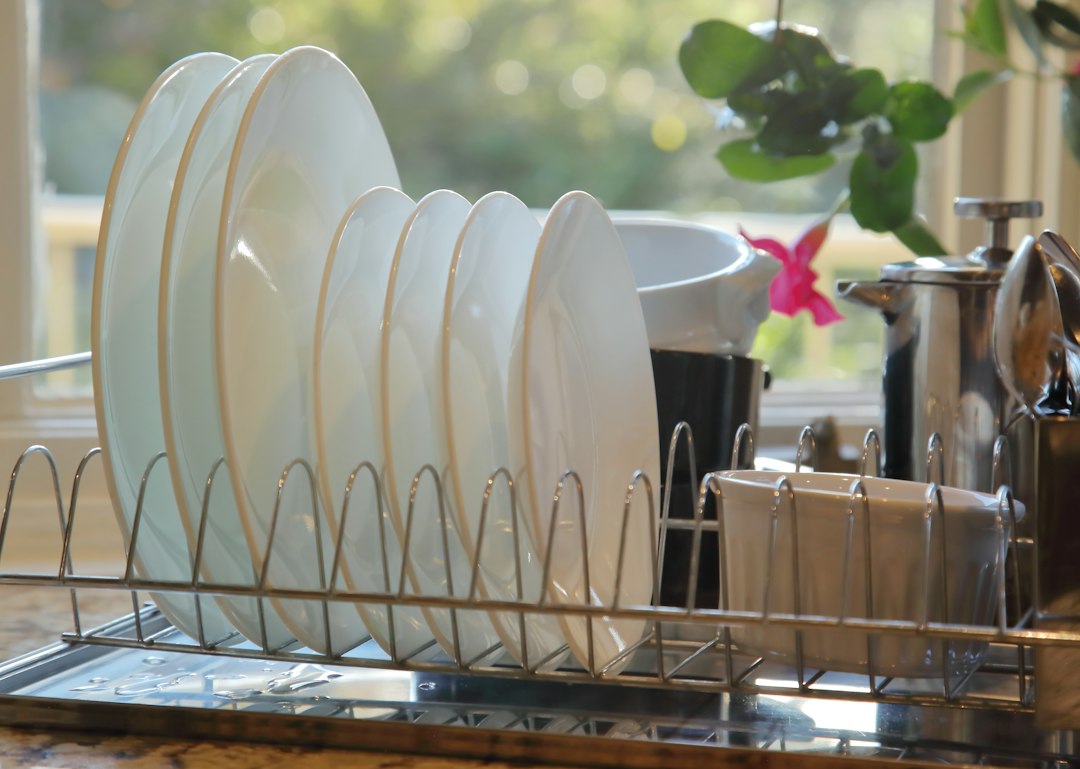
A dish rack is one of the few things in a small kitchen that has to stay out while it works. The real tradeoff is straightforward: a rack that drains well and holds a real meal’s worth of dishes usually takes up meaningful counter space, while the compact options require you to rethink how and where you dry.
The right choice depends less on appearance than on your kitchen’s layout. A countertop rack may be the most practical option for everyday dishes. An over-the-sink rack can return counter space, but only if your sink, faucet, and cabinets cooperate. A roll-up or folding rack may be better if you need drying space only occasionally.
This is a research-based guide using manufacturer and retailer listing information. Dimensions and features can vary by version or listing, so confirm the current product details before ordering.
Things Well Chosen may earn a commission from qualifying purchases made through links in this guide, at no additional cost to you.
What actually matters in a small-kitchen dish rack
Start with the sink, not just the counter
A rack’s relationship to the sink determines whether water ends up where it should. Before looking at capacity, measure the sink length, usable rim or support area, faucet height, and the space between the counter and any upper cabinets.
A rack that fits the counter but cannot drain toward the sink will need a tray, towel, or frequent wiping. That may be manageable for occasional use, but it becomes tedious if the rack stays out every day, especially if you are setting up a small kitchen so it recovers quickly after a meal.
Check cabinet clearance above the counter
Tall racks can use vertical space efficiently, but upper cabinets often make that space unavailable. Measure from the countertop to the bottom of the cabinets, not from the floor or cabinet exterior.
Also consider doors and under-cabinet lighting. A rack may technically fit while still making a cabinet door difficult to open or blocking the light you use over the sink.
Understand where water goes
There are three common drainage approaches:
- A countertop rack with a tray and spout directs water toward the sink.
- An over-the-sink rack lets water fall directly into the basin.
- A folding or roll-up rack may need to sit over the sink or use a separate mat or tray.
A rack’s footprint and its usable capacity are not the same thing. Bolsters, prongs, utensil holders, and drainage trays all occupy space without necessarily holding dishes. Look at how much of the rack actually supports plates, bowls, glasses, or cookware.
Pay attention to rust resistance
“Stainless steel” is not a complete description of corrosion resistance. A listing that identifies 304 stainless steel gives you more useful information than one that simply says stainless steel. Coated wire can also work well, but chips and scratches in the coating may expose the underlying metal to moisture.
This matters most when the rack sits beside a constantly wet sink. Drying the rack periodically and cleaning away mineral deposits will help, but the underlying material still matters.
Consider cleaning before capacity
Dish racks collect residue in predictable places: under trays, inside spouts, around feet, between prongs, and beneath utensil holders. A rack that comes apart or has removable components is easier to keep clean than one with fixed, narrow channels.
If the rack will remain on the counter permanently, choose a design you are willing to wipe down and rinse regularly. Convenience disappears quickly when cleaning requires a small brush and several separate steps.
Decide where it lives when it is not in use
A folding rack only saves space if you have somewhere practical to store it. Measure the folded dimensions and decide whether it will live in a drawer, cabinet, beside the sink, or vertically against a backsplash.
The same applies to roll-up racks. Their value is greatest when they can genuinely disappear rather than becoming another object leaned against the counter.
Think about pots and pans
Some racks are designed mainly for plates, bowls, and glasses. Others can handle a pan or small pot. If you regularly wash cookware by hand, look for open space and adequate support rather than assuming a rack’s listed capacity tells the whole story.
A rack that holds many plates but has nowhere stable for a saucepan may not suit your routine.

Five dish-drying racks for small kitchens
simplehuman Compact Steel Frame Dishrack: Best compact countertop rack for everyday use
Check current product options on Amazon
The simplehuman Compact Steel Frame Dishrack is a practical option for someone who needs a rack out every day but cannot give up a large section of counter.
Its brushed stainless steel frame measures approximately 15 inches wide, 15.5 inches deep, and 7.5 inches high. The rack uses a 360-degree swivel spout to direct water toward the sink, along with an anti-residue coating and moisture-control surface.
Who it is for
Choose it if you want a conventional countertop rack with directed drainage and enough structure for everyday plates, glasses, and utensils.
What problem it solves
It gives a small kitchen a real drying area without requiring a full-size rack or a permanently fixed drainage direction. The swivel spout is particularly useful when the rack needs to sit beside the sink rather than in one perfectly aligned position.
What to know before ordering
The approximately 15.5-inch depth is important. The rack may look compact because its width is only about 15 inches, but it still requires meaningful front-to-back counter space. Measure the usable depth beside your sink, including any backsplash lip or space needed to open drawers below.
Limitation
This is a light-to-moderate-capacity rack rather than a solution for a large meal’s worth of pots and pans. It also takes more counter depth than its compact width initially suggests.
Trustmade 3-Tier Over the Sink Dish Drying Rack: Best for returning counter space
Check current product options on Amazon
The Trustmade 3-Tier Over the Sink Dish Drying Rack is the high-capacity option for kitchens where counter space matters more than a low visual profile.
Retailer listings describe a stainless-steel structure that adjusts from approximately 23.5 to 36.6 inches wide, with a depth of about 11 inches and an overall height around 32.5 inches. The design includes hooks and a utensil holder, so the rack becomes the primary drying area rather than just a shelf for plates. Verify the material grade and dimensions of the specific listing before ordering.
Who it is for
Choose it if you have a wide enough sink, tall enough faucet clearance, and enough open vertical space above the basin to support a three-tier structure.
What problem it solves
Because it sits over the sink, water drains directly into the basin and the rack returns the counter area that a traditional drainer would occupy. The multiple levels also give you more capacity without spreading across the counter.
What to know before ordering
The listed fit requirements are unusually important. Measure sink width and surrounding countertop clearance against the chosen width; check faucet clearance against the shelves; and allow at least the full rack height, approximately 32.5 inches, beneath any upper cabinets. Confirm the precise fit instructions on the version you buy.
Measure all three dimensions before ordering. Do not rely on the sink’s nominal cabinet size.
Limitation
The height rules out many small kitchens. Low upper cabinets, tall faucets, windows, and under-cabinet lights can all interfere. A three-tier rack can also make the sink feel occupied while you are cooking.
Yamazaki Tower Folding Drainer Rack, Small: Best for occasional drying
Check current product options on Amazon
The Yamazaki Tower Folding Sink Drainer Rack, Small, is designed for households that do not need a full drying rack sitting out all day. Yamazaki lists its dimensions as approximately 16.5 by 10.2 inches and 0.3 inch thick. It folds or rolls up for compact storage and is intended for sinks with a front-to-back span of roughly 15 inches or less.
The rack uses coated, plated steel with silicone end caps. Yamazaki specifies a maximum load of about 8.8 pounds. You can adjust its width by folding partway, and individual bars can be removed or repositioned to work around a faucet.
Who it is for
This is a sensible fit for one-person households, small households, occasional hand-washing, or kitchens where most dishes go directly into a dishwasher.
What problem it solves
It creates a temporary drying surface that can be stored in a drawer or beside the sink. It can also be folded partway when you need support without using the full surface.
What to know before ordering
The rack is better suited to controlled, light-use drying than to a full dinner’s worth of dishes. If you use it on the counter rather than over the sink, plan to place a tray or mat underneath.
Limitation
It is not built for large loads of plates plus pans. Its value comes from folding away, not from replacing a large everyday dish rack.
Seropy Roll Up Dish Drying Rack: Best for kitchens with almost no storage
Check current product options on Amazon
The Seropy Roll Up Dish Drying Rack offers a flat, temporary drying surface. Listings describe stainless-steel tubes with silicone ends and dimensions of approximately 17.5 by 11.8 inches. The claimed load limit is up to 33 pounds; retailers also advertise heat resistance up to about 400°F and dishwasher-safe care. Confirm those claims for the exact variation purchased.
It is designed for sinks no wider than approximately 16.5 inches and is not suitable for uneven farmhouse-style sinks.
Who it is for
Choose it if there is genuinely no place to store a conventional rack and your sink can support the rack securely on both sides.
What problem it solves
The rack rolls up to roughly the width of a rolled magazine and can go into a drawer when it is not needed. It drains directly into the sink without a separate tray or spout.
What to know before ordering
This is a flat drying surface, not a tiered dish rack. It works for glasses, plates set flat, produce, or a hot pan, but it has no dedicated utensil holder and offers limited capacity for multiple dishes at once.
Measure the sink’s supporting width carefully. Both sides need to rest securely on the rim or counter.
Limitation
It will not work well with an uneven farmhouse-style sink or a basin that is too narrow to support its full width. It also requires more deliberate loading than a conventional rack.
Joseph Joseph Extend Expandable Dish Drainer: Best for a visible, design-conscious countertop
Check current product options on Amazon
The Joseph Joseph Extend Expandable Dish Drainer is intended for kitchens where the dish rack remains visible and needs to look reasonably intentional. It has an integrated drainage spout and expands only when extra length is needed.
Joseph Joseph lists the standard Extend model at approximately 12.5 by 14.25 by 6.25 inches when closed and 20.75 by 14.25 by 6.25 inches when extended. It includes removable non-scratch draining prongs, a removable steel rack, and a movable cutlery drainer. Do not confuse it with the narrower Extend Slim variant.
Who it is for
Choose it if you want a countertop rack that can stay compact most of the time but provide more room when you wash a larger load.
What problem it solves
The expandable design helps avoid committing the full counter to a longer rack every day. Its removable components also make it more practical to dismantle and clean than a fixed, one-piece tray.
What to know before ordering
The rack is hand-wash only, and the manufacturer notes that it should be cleaned by hand. The drainage spout also needs to be positioned over the sink, so it cannot sit just anywhere on the counter.
Limitation
It requires more maintenance than a dishwasher-safe or open roll-up design and costs more than simpler plastic options. Its expandable length is useful only if you have enough counter depth and a suitable position beside the sink.
Why an over-the-sink rack isn’t automatically the answer
An over-the-sink rack can be the best way to recover counter space, but it is not universally practical.
The faucet may be too tall. The upper cabinets may be too low. The sink may be too short or narrow to support the rack. A tall rack can block a window, interrupt under-cabinet light, or make the sink feel awkward to use while you cook.
There is also a less obvious tradeoff: an over-sink rack frees the counter only if you commit to emptying it. If dishes remain on the rack for days, the sink becomes a permanent storage zone instead of a work area.
These racks make the most sense over wide sinks with tall faucets and generous cabinet clearance. If your layout does not meet those conditions, a modest countertop rack with a directed spout may be more useful.
For the same reason, measuring the sink rather than assuming the counter will work is essential. Our guide to Best Over-the-Sink Cutting Boards for Small Kitchens covers the same fit principle in another sink-area category.
What we would skip
Some dish-rack designs add more inconvenience than organization:
- Racks with integral drainboards that hold water and develop residue
- Oversized two- and three-tier towers in kitchens with low cabinet clearance
- Fixed trays that cannot be removed for cleaning
- Lightweight dividers or feet that constantly shift
- Racks that fill the entire counter and leave no flexible space
- Designs that must be unloaded before the sink is usable
- Wire racks with uncoated or thin plating in kitchens where rust already appears
The goal is not to maximize the number of dishes a rack can hold. It is to make drying easier without creating another permanent obstacle.
A dish rack should earn its place the same way any other visible kitchen object does. Our guide to The Things That Actually Make a Kitchen Counter Feel Less Cluttered offers a useful rule: frequently used items can stay, but they still need a defined boundary. The same standard applies to kitchen tools that justify the space they occupy.
The Things Well Chosen recommendation
Match the rack to the sink and cabinet clearance first, then to the number of dishes you actually leave to dry.
A modest rack with directed drainage may suit everyday use better than a larger rack that permanently occupies the counter. The simplehuman Compact provides a conventional countertop setup, a tall over-sink design such as the Trustmade may work when the measurements permit, and the Seropy suits kitchens where compact storage is the primary constraint.
The best rack is the one you will actually empty every night.
Featured photograph: Anna Khromova / Unsplash.