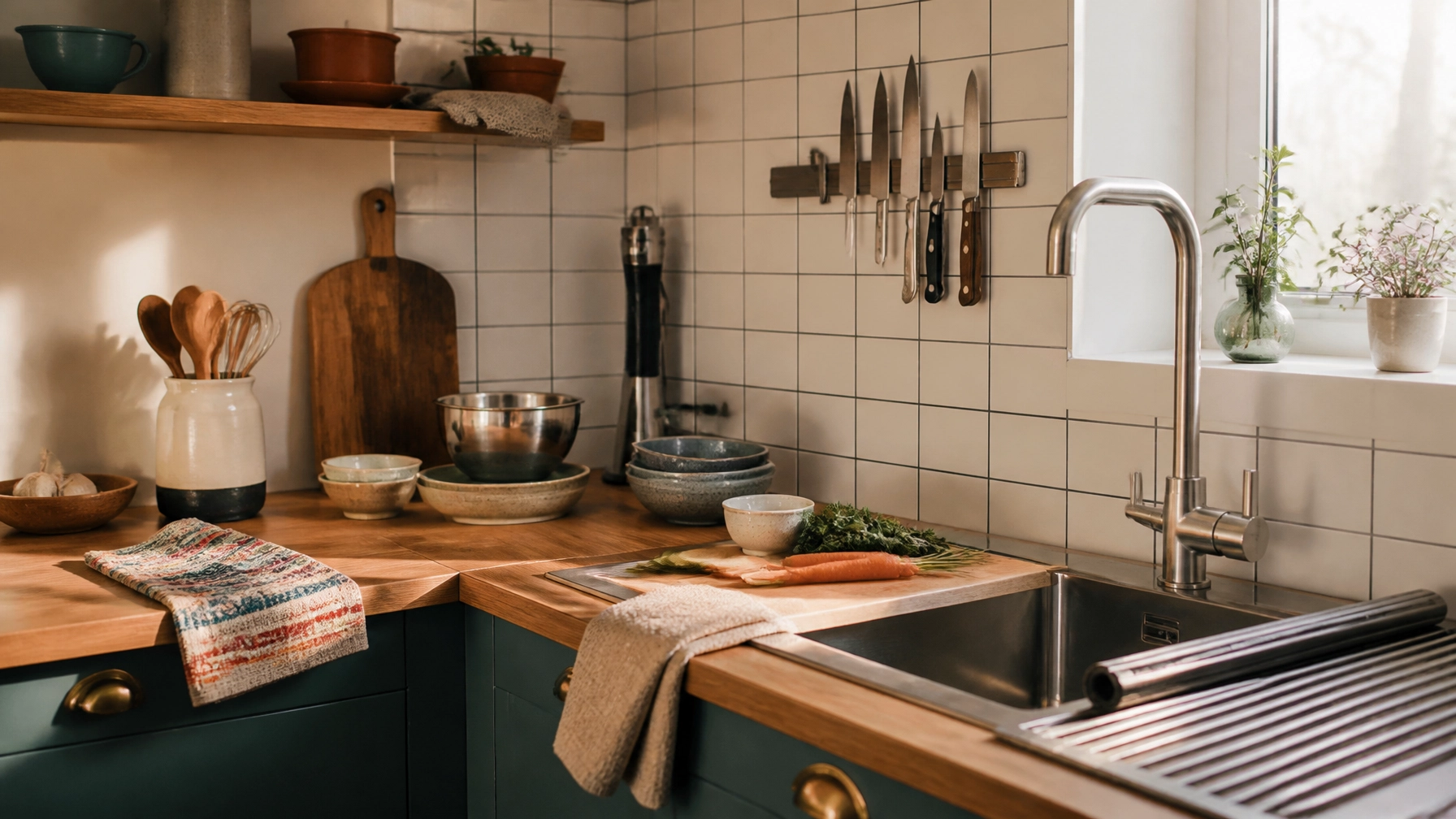
A small kitchen does not necessarily need fewer useful tools. It needs fewer mediocre ones.
Every cutting board, bowl, appliance, and organizer competes for limited drawer, cabinet, or counter space. That raises the standard. A tool should solve a problem you encounter often, replace more than one bulky item where appropriate, store efficiently, or noticeably improve cooking and cleanup.
The seven categories below are worth considering because they can do more than look clever in a small space. None is universally right for every kitchen, though. The useful question is not whether a product saves space. It is whether it saves enough space and effort to justify the room it still takes up.
For broader layout and organization ideas, see our guide to Small Kitchen Fixes That Make a Big Difference. This list takes a narrower view: tools that earn their physical place through repeated use.
1. An over-sink cutting board or workstation
The problem it solves: You need more prep surface but have little or no counter space.
An over-sink cutting board turns the sink into temporary workspace. Depending on the design, it may also hold a colander or bowl for rinsing produce and collecting scraps. That combination can make meal prep more comfortable without requiring a permanent counter extension.
It is most useful for apartment kitchens, galley layouts, and anyone who regularly prepares vegetables, fruit, sandwiches, or small meals. It can also help when the sink is wider than the available counter.
Look for:
- A stable fit for your actual sink width
- A board that does not flex noticeably under a mixing bowl
- Secure, non-slip supports or extendable arms
- A smooth surface that is easy to clean
- A removable colander only if you will genuinely use it
The details that are often not worth paying extra for include elaborate juice channels, multiple attachments, and overly complicated sliding parts. Each added feature creates another surface or crevice to clean.
The main tradeoff is fit. An over-sink board that sits unevenly, blocks the faucet, or leaves too little room for the basin is not useful storage: it is an awkward object in the way. Measure the sink before buying, including any divider, faucet clearance, and surrounding counter lip.
Skip it if: you already have a comfortable prep surface or your sink shape makes a stable fit unlikely.
2. A roll-up over-sink drying rack
The problem it solves: A conventional dish rack permanently occupies the counter.
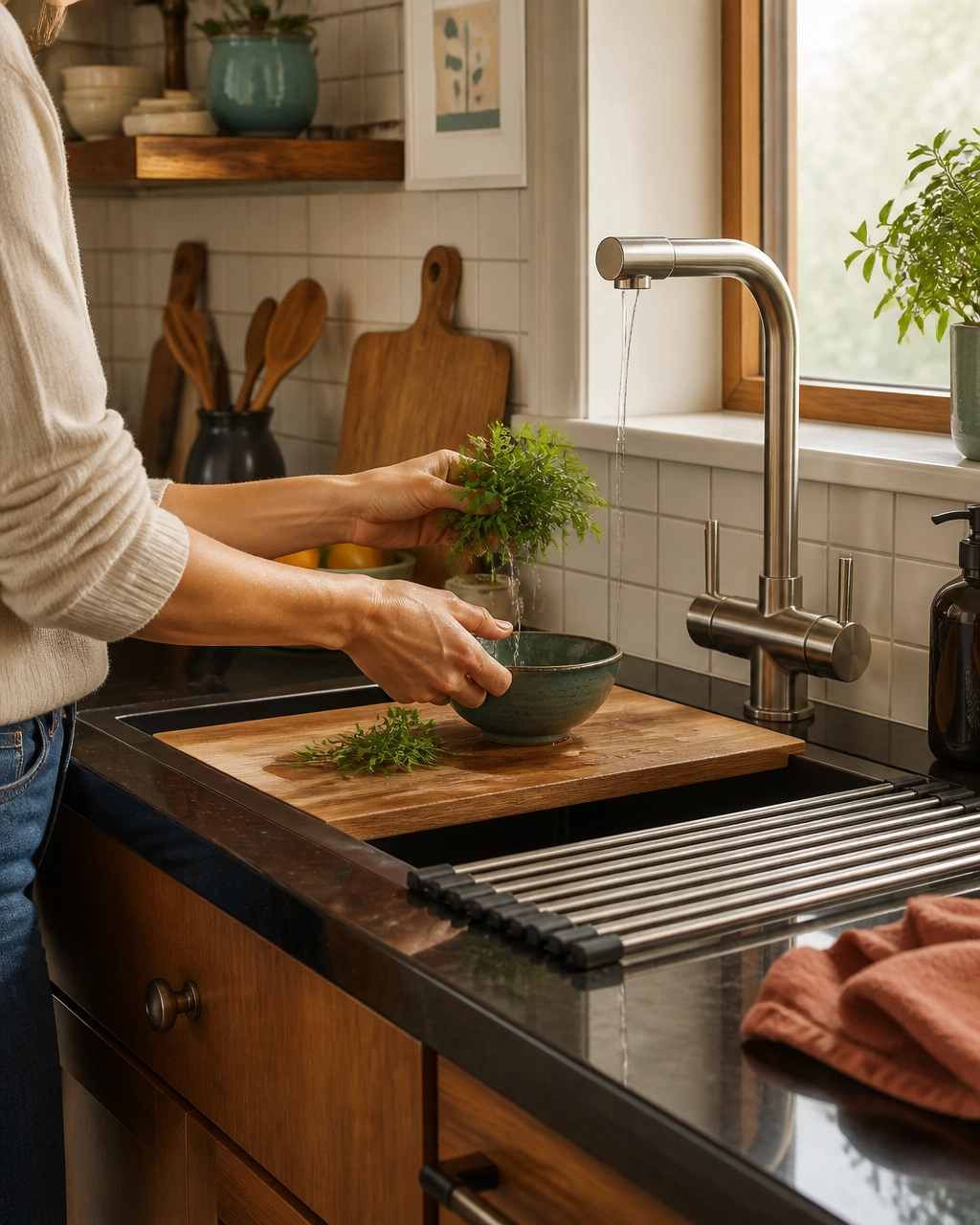
A roll-up rack uses the space above the sink for drying dishes, rinsing produce, or resting a hot item briefly, depending on its construction and stated heat resistance. When the sink area needs to work for another task, it can roll up and move to a drawer or cabinet.
This category makes particular sense for households that hand-wash only a few dishes at a time or need a temporary drying area rather than a full-size rack. It may also be useful for rinsing produce without setting a colander directly on the counter.
Prioritize:
- A length and width that match your sink
- Sturdy, corrosion-resistant rods
- Non-slip ends that sit securely on the counter or sink rim
- Enough support for the dishes you typically wash
- A design with few tight crevices and easy-to-rinse surfaces
Do not assume every roll-up rack is suitable for hot cookware. If you want to use one as a trivet, verify the manufacturer’s heat guidance rather than treating the feature as universal. Thin rods, loose silicone ends, and racks that sag under ordinary dishes are also poor compromises.
The tradeoff is capacity. A roll-up rack is usually better for controlled, short-term drying than for a household that washes a large load of dishes by hand.
Skip it if: your sink is too small for a stable fit or you need more drying capacity than the rack can reasonably provide.
3. Nesting mixing and prep bowls
The problem they solve: Several bowl sizes consume the space of several bowl sizes.
A well-designed nesting set gives you several useful bowl sizes for whisking, tossing, holding ingredients, serving, and sometimes storing leftovers while taking up little more cabinet space than the largest bowl. That is a straightforward form of space efficiency: the tools remain useful because they are not sacrificing the primary job of a bowl.
Nesting bowls are especially worthwhile for people who cook from ingredients rather than relying entirely on one-pot meals. They are also useful in kitchens where cabinet shelves are shallow or where loose bowls tend to become an unstable stack.
Look for smooth interiors, sturdy rims, and shapes that nest without requiring careful rearrangement. Stainless steel is durable and light, while glass or thick, well-made plastic may offer advantages for storage or microwave use. Choose based on your routine rather than assuming one material is best for every kitchen.
Features that may not justify a higher price include built-in graters, elaborate lids, unusual shapes, and measurement markings you are unlikely to use. A lid is useful when it fits securely and stores neatly; a collection of loose lids can erase the space savings.
The tradeoff is that a nested set may not include the exact size or depth you need. Some lightweight bowls also move around while mixing, while heavier materials take more effort to lift and store.
Skip it if: you already own a compact set of bowls that stacks well and your kitchen has no recurring bowl-storage problem.
4. A magnetic knife strip or other vertical knife storage
The problem it solves: Knives take up valuable drawer space and become difficult to retrieve safely.
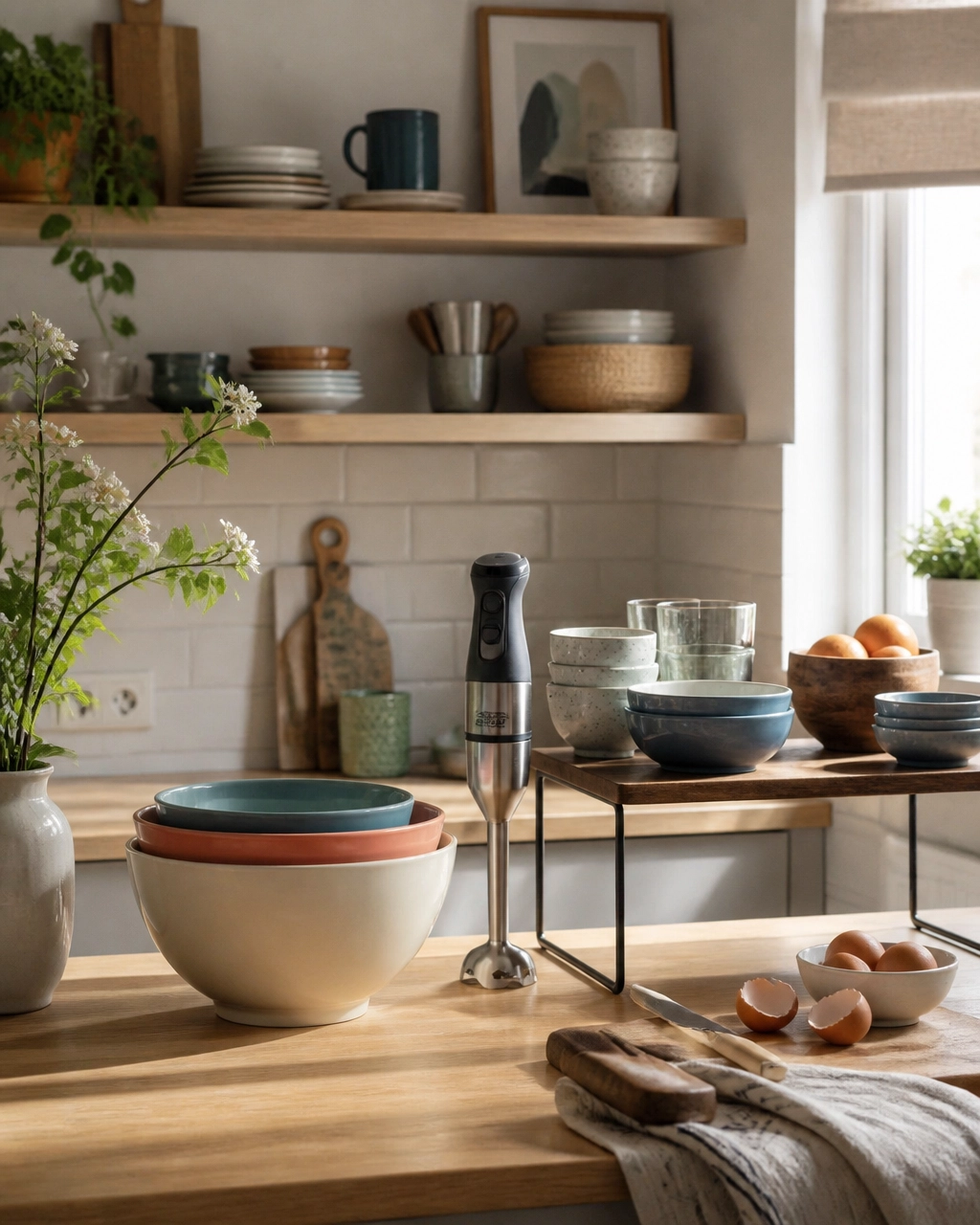
Vertical knife storage can free valuable drawer space and make frequently used knives easier to identify and retrieve. A magnetic strip is one option; a wall-mounted knife block or slim in-cabinet rack may be better for renters, households with children, or anyone who prefers concealed storage.
The important features are not decorative wood species or oversized capacity. Look for secure mounting, enough length for the knives you actually own, and a surface that holds each knife firmly without requiring forceful removal. Installation hardware matters because a storage solution is only as good as its attachment to the wall.
Avoid paying for a strip sized for an imaginary knife collection. More capacity usually means more visual presence, not more usefulness. Also be cautious with magnetic designs that leave blades exposed in a busy walkway.
The tradeoffs are safety, installation, and appearance. Wall-mounted storage requires drilling in many cases, and open knives may not suit every household. A strip also needs to be positioned where handles and blades will not interfere with nearby cabinets or food preparation.
Skip it if: you rent without permission to mount it, have young children who can reach it, or already have a safe drawer insert that works well.
5. A compact immersion blender
The problem it solves: You want to blend soups, sauces, dressings, or small batches without storing a full-size blender.
An immersion blender stores in a drawer or narrow cabinet and can often blend directly in a pot or tall container. That makes it useful for cooks who prepare soups, sauces, purées, or smaller portions more often than smoothies and frozen drinks.
Choose a model with a detachable blending shaft, a comfortable grip, and food-contact parts that are straightforward to wash. A stainless-steel shaft can be a sensible durability choice. If the product includes a whisk or chopper attachment, consider whether you will use it enough to justify storing it.
Extra speed settings, oversized accessory kits, and a storage stand are not automatically valuable. A large set can turn one compact tool into several loose pieces. The best version is one whose core function justifies the space it takes up without relying on a large collection of attachments.
The tradeoff is capability. An immersion blender may not produce the same results as a full-size blender for large batches or very smooth frozen drinks. It can also splash if used in a shallow container.
Skip it if: you rarely blend anything or already own a countertop blender that handles your routine without creating storage problems.
6. A shelf riser or vertical cabinet organizer
The problem it solves: Cabinet height is being wasted, while short stacks of dishes or pantry items become difficult to reach.
A shelf riser creates a second level inside a cabinet. A vertical divider can do a similar job for cutting boards, baking sheets, trays, or lids. These are not exciting purchases, but they can make existing storage significantly easier to use without adding another piece of furniture.
This category benefits people with tall cabinets, deep shelves, or a collection of flat items that currently lean in an unstable pile. It earns its place when it improves access as well as capacity. If you can remove one plate without disturbing everything around it, the organizer is doing useful work.
Prioritize dimensions, load stability, and a surface that will not slide easily. Adjustable versions can be helpful when the cabinet may change, but adjustment mechanisms should not make the unit wobbly or difficult to clean.
Do not pay for elaborate modular systems when a simple, correctly sized riser will solve the problem. Avoid organizers that make a cabinet technically hold more while leaving no clearance to remove anything.
The tradeoff is that every riser also takes up some vertical and horizontal room. Poorly chosen versions can reduce flexibility rather than improve it.
Skip it if: your cabinets are already easy to access or you have not edited out duplicate dishes and unused pantry items first.
7. A compact toaster oven: only when it replaces something
The problem it solves: You need small-batch baking, reheating, or toasting without relying on a full-size oven or keeping several separate appliances.
A compact toaster oven is the one category on this list that deserves unusually strict scrutiny. It can earn its footprint when it replaces a toaster and gets frequent use for reheating, roasting, or cooking smaller portions. It may also reduce the need to heat a full-size oven for modest tasks.
Before buying, measure the available counter depth and check the required clearance around the appliance. Then consider capacity. A model that cannot accommodate the dishes or portions you actually cook may be too limited, while a larger one may consume the space it was supposed to save.
Useful features include removable racks and a crumb tray, controls that are easy to wipe, and a door and rack system that feel sturdy. Preset programs and digital displays are secondary. They are not worth much if the appliance is difficult to clean or awkward to store.
The tradeoff is permanent footprint and heat. Unlike the other tools here, a toaster oven usually needs a designated counter position and cannot simply disappear into a drawer after use. It may also duplicate an oven, toaster, or air fryer.
Skip it if: you do not expect to use a small oven frequently, cannot provide the manufacturer-required countertop clearance, or already have another appliance covering the same jobs.
The space test for anything else
Before bringing home another kitchen tool, ask five questions:
- What recurring problem does it solve?
- How often will I realistically use it?
- Does it replace or improve on something I already own?
- Can I clean it without adding an unwanted chore?
- Where will it live when the task is finished?
A product does not earn space merely because it folds, nests, mounts, or collapses. Those features matter only when the tool still performs its main job reliably.
The strongest small-kitchen purchases are usually quiet ones: a workstation that creates prep space, bowls that store as one, a blender that replaces a larger machine, or an organizer that makes existing cabinets easier to use. For more practical ideas, explore the Things Well Chosen Kitchen section. The goal is not to fit more into the room. It is to make room for the tools you will actually reach for.