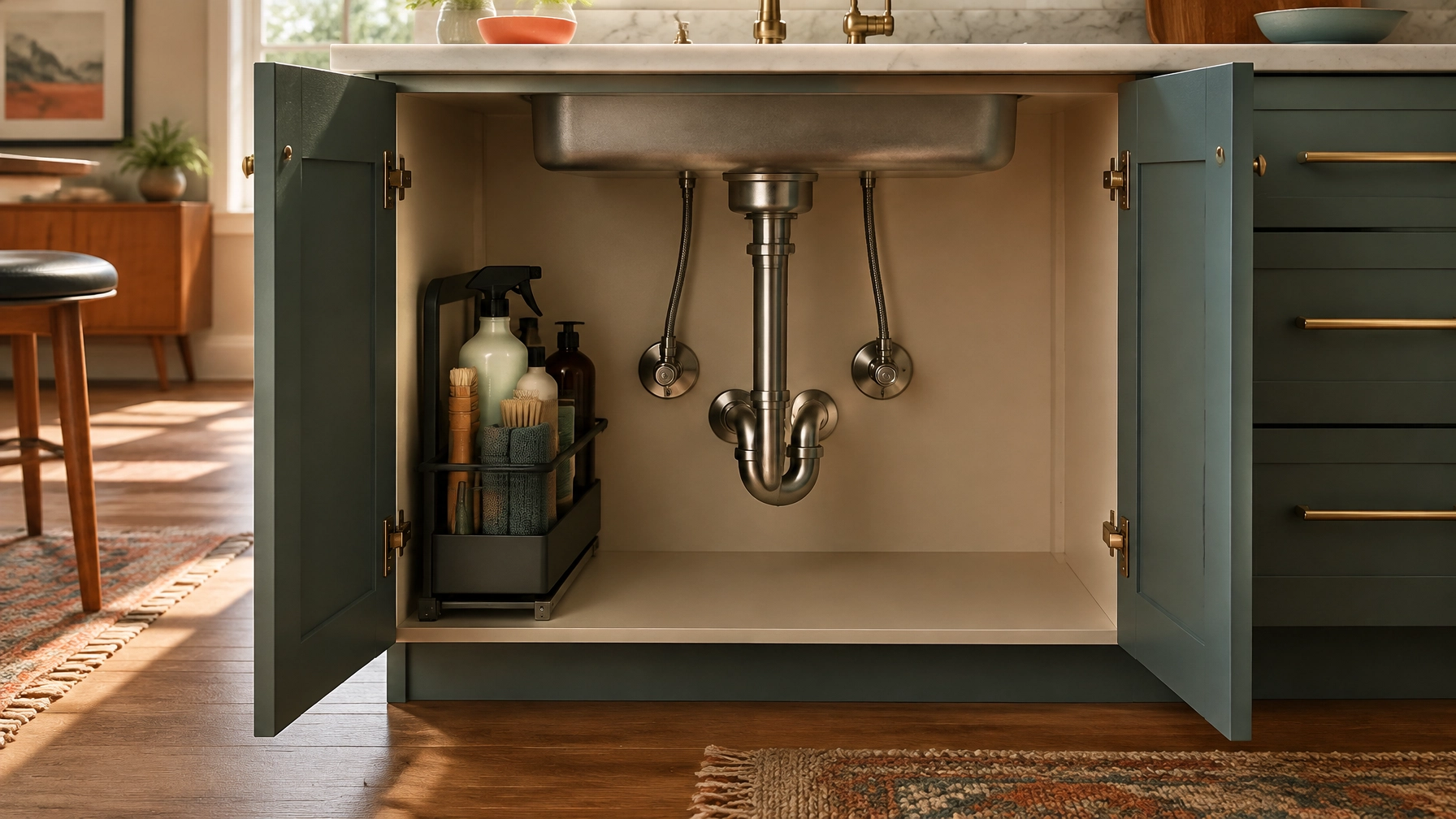
Under-sink cabinets are unusually difficult to organize because the usable space is interrupted by everything a normal cabinet does not have: drainpipes, P-traps, garbage disposals, water filters, supply lines, hinges, and tall bottles competing for the same few inches.
That is why the best under-sink organizer is not necessarily the one that holds the most. It is the one that fits your actual cabinet, leaves the plumbing accessible, and lets you reach what you store without unpacking the entire space. The same principle applies on the counter: giving everyday items a clear boundary usually works better than trying to eliminate them entirely.
Things Well Chosen may earn a commission from qualifying purchases made through links in this guide, at no additional cost to you.
What Actually Matters in an Under-Sink Organizer
Measure the usable space, not just the cabinet
Start inside the cabinet. Measure the narrowest usable width between hinges, side walls, and the cabinet frame, then measure depth and height to the lowest obstruction. A unit can technically fit inside the cabinet and still keep the door from closing or collide with plumbing as it slides.
Work around the obstruction instead of across it
Look at where the plumbing actually sits. A disposal may take up one side while a P-trap interrupts the center. The most useful systems either leave sections open, use an L-shaped profile, occupy a narrow lane beside the obstruction, or can be lifted out quickly if you need to inspect a leak.
Make sure pull-outs have a clear path
A sliding organizer is only useful if the drawer clears the cabinet opening, hinges, raised front lip, and pipes for its entire travel. Check that path before buying, not after installation.
Leave room for bottles and maintenance
Measure your tallest spray bottle and keep shutoff valves reachable. Under-sink storage should also leave enough visibility to notice moisture on the cabinet floor. Organization that makes a leak harder to find is not an upgrade.
Choose materials that tolerate moisture
Finished metal and wipe-clean plastic are practical in a humid cabinet where spills happen. The goal is not waterproof storage; it is an organizer that can be cleaned easily and removed without becoming another maintenance project.
The Best Under-Sink Organizers That Work Around Plumbing
Simple Houseware 2-Tier Heavy Duty Expandable Organizer
Best for: Cabinets with plumbing that cuts through the middle of otherwise usable space.
This expandable two-tier rack is one of the more forgiving options for awkward plumbing because its width adjusts from about 15.75 to 25 inches and the shelf panels can be arranged around pipes instead of forcing a solid shelf across them. The four shelf-height positions also give you some control over bottle clearance.
The open metal construction makes it easy to see where the plumbing sits and keeps the system from feeling like a bulky box inside the cabinet. It does not pull out, however, so items stored at the back will still require some reaching. Choose it when adaptability around a centered or irregular pipe layout matters more than drawer access.
REALINN L-Shaped 2-Tier Pull-Out Under Sink Organizer
Best for: Cabinets with a disposal or plumbing occupying one side.
The REALINN uses an L-shaped upper tier to leave room for plumbing while reclaiming storage below. The black two-pack version measures about 14.2 inches deep, 10.6 inches wide, and 11 inches high per unit, and the lower basket slides forward so bottles are easier to reach.
This is a better fit than a full-width rack when you have a clear lane beside the disposal. The limitation is that the L-shape only helps when your obstruction is in the right place. Measure both the plumbing position and the drawer path before ordering. If the geometry matches your cabinet, the combination of vertical storage and pull-out access is hard to beat.
LYNK PROFESSIONAL Pull-Out Cabinet Organizer, 11 x 21 Inches
Best for: A narrow open zone beside a disposal, filter, or supply lines.
A single low-profile slide-out shelf can be more useful than a large under-sink system when the cabinet has one clean strip of floor space. This LYNK organizer is about 11 inches wide by 21 inches deep and four inches high, so it turns that narrow lane into storage you can pull toward you.
Its strength is restraint: it does not try to organize the entire cabinet. You can keep taller bottles on the shelf without an upper tier getting in the way, and the slide-out action makes a deep cabinet easier to use. Installation is more permanent than a freestanding bin because the organizer mounts inside the cabinet, so it makes the most sense when you know the layout works.
YouCopia SinkSuite Under Sink Turntable
Best for: Bottle-heavy cabinets where reaching the back is the main problem.
The SinkSuite takes a different approach: instead of sliding forward, the 12-inch turntable rotates 360 degrees so the back of the cabinet comes to you. It includes three adjustable dividers, non-slip feet, and a low 3.3-inch profile, with a stated capacity of up to 30 pounds.
It works best beside the plumbing rather than directly beneath the drain. The round footprint is less space-efficient than a rectangular bin, and it does not add vertical storage, but that tradeoff can be worthwhile when the real annoyance is losing bottles behind other bottles. It is also easy to lift out if you need access to the cabinet floor.
Command Large Organizing Caddy
Best for: Using the inside of the cabinet door without drilling.
If the cabinet floor is crowded, the door may be the most useful unused surface. This Command caddy measures roughly 8.6 by 3.1 by 3 inches and mounts with adhesive strips rather than screws, making it a low-commitment place for sponges, dishwasher tablets, gloves, or other lighter supplies.
The caddy is intentionally small and is rated to hold up to four pounds, so it should not become a home for a row of full cleaning bottles. You also need enough clearance between the door and the plumbing for it to close. Used selectively, though, it can move the small things that usually float around the cabinet into an easy-to-reach zone.
mDesign Stackable Open-Front Storage Bins, 2-Pack
Best for: Irregular cabinets where a removable, modular system makes more sense than one large organizer.
Sometimes the best answer is not another rack. These clear open-front bins come as a two-pack and can be stacked where the cabinet has usable vertical room. Because they are freestanding, you can position them only where the plumbing allows and move them quickly if you need to reach a valve or inspect the floor.
They are less convenient than a true pull-out in a very deep cabinet, and stacking only works when the pipe layout leaves enough height. But for a cabinet with several small pockets of usable space, modular bins often create a calmer result than forcing one oversized organizer around every obstruction.
Before You Buy: Measure These Four Things
1. Cabinet interior width. Measure the narrowest usable width, including hinges, side walls, and any face frame.
2. Cabinet interior depth. Measure from the usable front edge to the back wall, and note any raised front lip a drawer would have to clear.
3. Available height. Measure from the cabinet floor to the lowest pipe or obstruction, then compare that with the tallest bottle you want to store.
4. Plumbing and disposal location. Note which side the obstruction occupies, how far it protrudes, and whether it sits high, low, centered, or toward the back. Include filters, supply lines, and shutoff valves.
Always compare those measurements with the exact product listing before ordering. Small differences between variants matter more under a sink than they do in most cabinets.
What We Would Skip
Huge fixed shelving units that ignore plumbing. They may advertise impressive capacity, but a shelf that collides with the drain or disposal wastes more space than it creates.
Deep solid bins that hide the back row. If you have to unload half the container to retrieve one bottle, the organizer has not actually improved access.
Flimsy multi-tier systems. Full cleaning bottles add weight quickly. Thin shelves that bow or shift are not worth the extra tier.
Anything that blocks shutoff valves or hides the cabinet floor. You should be able to reach the valves and spot moisture without dismantling the entire system.
As with other kitchen items that earn the space they take up, the useful question is not how much an organizer can hold on paper. It is whether it removes friction in daily use.
The Things Well Chosen Recommendation
The best under-sink setup is usually a combination of easy access, modest capacity, and flexibility around plumbing—not an attempt to fill every inch.
Start with the clearest usable zone. If pipes interrupt the center, an expandable rack is the most adaptable choice. If you have a clean lane beside a disposal, a narrow pull-out can make better use of depth. Add a turntable, door caddy, or removable bin only when it solves a specific remaining problem.
That approach is less dramatic than installing a complete cabinet system, but it is more likely to leave you with storage that works around the plumbing rather than fighting it—and it follows the same practical logic as making a small kitchen work harder without crowding it.