
An over-the-sink cutting board can add useful prep space to a small kitchen, but only if it fits securely and leaves enough room to work. The wrong board can wobble, block the faucet, cover too much of the sink, or introduce a collection of accessories that are harder to clean than they are useful.
This is a researched buying guide, not a firsthand product test. We prioritized products with clearly documented materials, construction, fit requirements, and current U.S. availability, and we flag where important sizing information still needs confirmation. The shortlist is intentionally small because the differences between these products matter more than the number of options.
Disclosure: This article contains affiliate links. As an Amazon Associate, Things Well Chosen earns from qualifying purchases at no additional cost to you.
Our Shortlist
- Dexas Over the Sink Poly Cutting Board with Collapsible Colander Strainer , the most practical choice for a generic sink and a small budget.
- Crate & Barrel Over-the-Sink Colander and Cutting Board , a more design-conscious composite option, provided its current dimensions work for your sink.
- KRAUS KCB-WS301SA Workstation Kitchen Sink Wood Grain Composite Cutting Board , the better choice for an existing KRAUS workstation sink that needs a larger prep surface.
- Lipper International Bamboo Over-the-Sink Expandable Cutting Board (#8841) , the best adjustable option for readers who need more span than a fixed board can provide.
The most important decision is not material, color, or accessory count. It is fit. A beautifully made board that does not sit securely is a bad purchase.
Quick Comparison
| Product | Best for | Material | Size | Adjustable? | Useful extra | Main tradeoff |
|---|---|---|---|---|---|---|
| Dexas Over-the-Sink Strainer Board | Conventional sinks / easy cleanup | Poly board | 20 × 11.5 × 1 in. | No | 2.5-qt collapsible strainer | Fixed span |
| Crate & Barrel Over-the-Sink Board | Design-conscious kitchens | Richlite paper composite | Confirm before purchase | No adjustment listed | Collapsible silicone/steel colander | Hand-wash only; availability may be limited |
| KRAUS KCB-WS301SA | Compatible KRAUS workstation sinks | Wood-grain composite | 16⅞ × 11 × ¼ in. | No | None | Sink-specific |
| Lipper International #8841 | Wider sinks / adjustable fit | Bamboo | 23.75 × 11.5 × 0.75 in. closed; expands to 34 in. | Yes | None | Larger storage footprint; hand-wash |
Dimensions and features can change by model, color, or retailer. Confirm the current product page before ordering.
1. Dexas Over the Sink Poly Cutting Board: Best Practical Choice for a Generic Sink
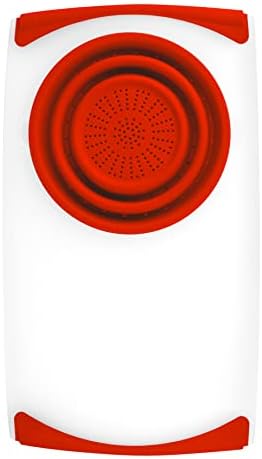
The Dexas Over the Sink Poly Cutting Board with Collapsible Colander Strainer is the most straightforward option on this list. It is designed as a standalone over-the-sink board rather than as an accessory for one particular sink system.
Why we selected it
The design concentrates on two useful functions: a cutting surface and a removable strainer. The board measures 20 inches long by 11.5 inches wide and 1 inch thick. Its non-slip rubber edges are intended to grip the supporting surface, and the included strainer collapses for storage.
The strainer has a documented 2.5-quart capacity and can also be used separately as a colander. The board is made from polyethylene, which Dexas describes as durable, non-porous, odor-resistant, and gentle on knives. The product listing also identifies the board and strainer as dishwasher safe.
That combination makes more sense than many large accessory bundles. The colander has a clear purpose: rinse or drain produce directly over the sink.
Who it suits
This is the best fit for:
- Renters or homeowners with a standard sink rather than a workstation sink
- Kitchens where counter space is genuinely limited
- Shoppers who prioritize easy cleanup over a furniture-like wood board
- Anyone who wants an integrated strainer without committing to a sink-specific system
Fit and construction
The board is a fixed-size, rim-supported design. It does not use telescoping arms or a documented adjustment mechanism. Instead, the rubber edges are meant to grip the surfaces supporting the board.
That makes the sink’s outside support width particularly important. Measure the area from one supporting edge to the other, not just the inside of the basin. Also check whether the sink rim is level and wide enough to support the board without rocking.
What we like
- Clear, useful accessory rather than an oversized bundle
- Removable colander is easier to handle than a permanently attached insert
- Dishwasher-safe construction simplifies cleanup
- Fixed dimensions avoid the potential looseness of telescoping rails
- Compact enough to store more easily than a large wood workstation
Potential drawbacks
The board is only 1 inch thick, and plastic will not have the visual or tactile presence of a substantial hardwood board. A raised edge and juice-channel design may also reduce the uninterrupted cutting area slightly.
The board is not adjustable, so there is no substitute for measuring. A 20-inch length may work well across one sink but be awkward on another, especially if the counter lip is narrow, uneven, or interrupted by a double-basin divider.
Who should skip it
Skip the Dexas if you want a large, heavy wood surface for frequent batch preparation, or if your sink needs a board with adjustable arms. It is also not the right choice for a KRAUS workstation sink where a ledge-mounted accessory would provide a more secure fit.
2. Crate & Barrel Over-the-Sink Colander and Cutting Board: Best for a More Refined Material Palette
The Crate & Barrel Over-the-Sink Colander and Cutting Board is the most visually considered option in this group. Its cutting surface is made from Richlite paper composite, with a removable collapsible colander made from silicone and steel. Silicone feet are also listed as part of the design.
Why we selected it
The material choice sets it apart from the many bamboo-and-plastic combinations in this category. Richlite is a paper-based composite rather than wood, giving the board a darker, more architectural look while avoiding some of the care concerns associated with natural wood.
The removable colander is a useful inclusion because it supports a real workflow: prepare ingredients on the board, move them into the colander, and rinse or drain them over the sink. It can also be removed when the full cutting surface is more useful.
Who it suits
This product is worth considering for:
- Shoppers who want an over-sink board that feels less utilitarian
- Kitchens where visible accessories need to coordinate with the room
- Readers who prefer composite materials to bamboo
- Anyone who values a removable prep accessory but does not need a large workstation kit
Fit and construction
Crate & Barrel describes the product as an over-the-sink board that fits over most sinks. However, the dimensions were not visible in the product information available for this review, and no adjustable span was documented.
That limitation matters. Before ordering, confirm the current length, width, thickness, and support geometry directly with Crate & Barrel. Do not rely on the phrase “fits over most sinks” as a substitute for measuring your own sink.
Treat it as a fixed, rim-supported design unless the current listing states otherwise. Check faucet clearance, the depth of the counter lip, and whether the board would interfere with a sink divider.
What we like
- Richlite composite is a distinctive alternative to bamboo or basic plastic
- Removable colander serves a clear purpose
- Silicone feet are intended to help keep the board in place while you work.
- Less visually busy than many overbuilt workstation kits
Potential drawbacks
The lack of readily visible dimensions makes this a more difficult recommendation to buy confidently. A product can be well designed and still be wrong for your sink.
Crate & Barrel currently lists this board as hand wash only, making it less convenient than the Dexas if dishwasher cleanup matters to you. It is also currently listed on clearance, so availability may be limited.
Who should skip it
Skip this option if you need a highly adjustable board, if your sink has unusual support geometry, or if you want exact fit information before making a purchase. It is also not the best choice for someone who wants the least expensive functional solution.
3. KRAUS KCB-WS301SA: Best for a KRAUS Workstation Sink with More Prep Area

The KRAUS KCB-WS301SA Workstation Kitchen Sink Wood Grain Composite Cutting Board is not a universal over-the-sink board. It is a dedicated accessory for compatible KRAUS workstation sinks.
Why we selected it
For the right sink, a ledge-mounted board can be more secure and more integrated than a generic board resting on the rim. The KCB-WS301SA measures 16⅞ inches long by 11 inches wide and ¼ inch thick. Its wood-grain composite construction provides a broad, shallow prep surface that sits on the sink’s integrated workstation ledge.
It is a good example of why a sink system can be more useful than a generic accessory: provided you already have the compatible geometry.
Who it suits
Choose this board if:
- You already own a KRAUS workstation sink
- Your sink’s specifications list the KCB-WS301 or KCB-WS301SA as a compatible accessory
- You want a relatively broad work surface over the sink
- You prefer composite construction to natural bamboo
Fit and construction
The board is designed to sit on the integrated ledge of a KRAUS workstation sink. It does not expand, telescope, or use extendable arms.
Do not purchase it based on length alone. KRAUS states that its workstation cutting boards are intended for the company’s workstation sink line, and compatibility varies by sink model. A sink with a similar opening may still lack the ledge depth or support points required by the board.
What we like
- Dedicated ledge support can provide a cleaner fit than a generic rim board
- 11-inch depth gives useful everyday prep space
- Composite construction avoids natural-wood maintenance
- No unnecessary colander or accessory bundle to store
Potential drawbacks
The board is only ¼ inch thick, so it is a different proposition from a thick butcher-block-style board. It also has no included strainer or bowl. That is a benefit for simplicity, but not if your primary reason for buying an over-sink board is rinsing ingredients.
Most importantly, it is not a general-purpose board for any sink.
Who should skip it
Skip it if you do not have a compatible KRAUS workstation sink, or if you need a board that can move between kitchens. If you are still choosing a sink, treat the board as one part of a larger workstation system rather than as a standalone purchase.
4. Lipper International Bamboo Over-the-Sink Expandable Cutting Board: Best Adjustable Option
The Lipper International Bamboo Over-the-Sink Expandable Cutting Board is the most flexible choice here for kitchens that need more span than a fixed board can provide.
Why we selected it
Unlike the fixed boards above, the Lipper expands from 23.75 inches wide to 34 inches wide. It measures 11.5 inches deep and 0.75 inch thick, with a cutting-board section measuring 20.5 by 9.25 inches.
That adjustability makes it useful for readers whose sinks are too wide for a fixed 20-inch board or who want a board that can also span part of a stovetop or counter area.
Who it suits
This is worth considering for:
- Wider sinks that need more than a fixed 20-inch span
- Readers who want an adjustable rather than sink-specific design
- Kitchens where a substantial bamboo work surface is useful
- Anyone willing to trade easier fit flexibility for additional storage size and wood maintenance
Fit and construction
The board expands to a maximum width of 34 inches. Do not assume that means it will fit every sink up to 34 inches; measure the actual support points and make sure enough of the board or extension mechanism will rest securely on both sides.
The bamboo construction requires more care than a dishwasher-safe plastic board. The manufacturer specifies hand washing with mild soap and cool water, thorough drying, no soaking, and occasional treatment with food-safe mineral oil.
What we like
- Much broader fit range than the fixed-size boards
- Substantial bamboo work surface
- No collection of accessories to store
- Can create temporary work space over a sink or other suitable surface
Potential drawbacks
Adjustability adds moving parts and the board is substantially larger to store than the Dexas. It is also not dishwasher safe, and bamboo requires more careful drying and maintenance.
Who should skip it
Skip it if a smaller fixed board already fits your sink securely, if dishwasher-safe cleanup is important, or if you do not have a practical place to store a board nearly 24 inches wide even when closed.
How to Choose an Over-the-Sink Cutting Board
Measure more than the sink opening
Before comparing products, measure:
- Sink width : measure the relevant support span from left to right.
- Sink opening : measure the basin opening, not just the outer sink dimensions.
- Front-to-back dimensions : include the usable depth of the sink rim or workstation ledge.
- Surrounding counter lip : note whether the board will rest on stone, laminate, a narrow rim, or a recessed ledge.
- Faucet clearance : check the faucet base, handle movement, and any pull-down sprayer.
- Double-basin dividers : determine whether the divider can support the board or will cause rocking.
- Usable workspace : account for colanders, bowls, handles, and the part of the sink that will remain accessible once the board is installed.
A product dimension is not automatically a fit dimension. The board may be 20 inches long, but the important question is where and how those 20 inches are supported.
A piece of cardboard cut to the listed dimensions can help you visualize counter overhang and faucet interference. It cannot confirm load-bearing stability, but it can reveal whether the board would make your sink awkward to use.
Choose the material based on maintenance
- Plastic or polyethylene: Usually the easiest to clean, and the Dexas board reviewed here is listed as dishwasher safe. It is practical for produce preparation and households that prioritize low maintenance.
- Bamboo: Offers a warmer appearance and a thicker, more traditional cutting-board feel. It requires more careful drying and should not be left immersed in water.
- Composite: Can provide a slimmer, more architectural design with less natural-wood maintenance. Care instructions vary, so do not assume dishwasher safety or heat resistance without verification.
Material quality matters, but it comes after fit and stability.
Fixed versus adjustable designs
Adjustable boards can span more sink widths, but adjustment mechanisms introduce additional parts that may flex, loosen, or collect food residue. A fixed board with broad, stable support can be the better design when it fits your sink precisely.
If you choose an adjustable model, look for clearly published minimum and maximum dimensions. “Fits most sinks” is not enough information by itself.
Simple board versus workstation system
A simple board is usually easier to store and clean. A workstation system can offer better integration, but only when the sink has the intended ledges or support points.
A colander is useful when you regularly rinse produce or drain ingredients directly over the sink. Extra bowls, trays, phone slots, knife holders, and storage features deserve more skepticism. Each accessory occupies space and adds another surface to wash.
Plan for storage
Measure the board when it is not in use. A 20-inch board may fit across the sink but not inside a standard cabinet. Thicker wood or bamboo boards often need to stand vertically, while collapsible accessories may reduce the total storage footprint.
The best over-sink board is one you can put away without creating a second storage problem.
Who Should Not Buy One
An over-the-sink cutting board is probably not worth buying if you:
- Already have enough counter space for a normal cutting board
- Have a sink with a narrow, uneven, or poorly supported rim
- Need unrestricted access to the entire sink throughout meal preparation
- Frequently wash large cookware while cooking
- Dislike storing a large board vertically or above the sink
- Have a double-basin sink with a divider that cannot support the board securely
- Prefer a dishwasher-only kitchen routine but are considering wood or bamboo
- Would get more use from a narrow counter board, folding prep surface, or wall-mounted solution
If the board blocks the faucet or turns a useful sink into an awkward shelf, it has not created workspace. It has only moved the inconvenience.
The Things Well Chosen Recommendation
For most readers with a conventional sink, the Dexas Over the Sink Poly Cutting Board with Collapsible Colander Strainer is the most sensible place to start. It has clear dimensions, a useful removable accessory, documented dishwasher-safe care, and no sink-specific workstation requirement.
For readers who need an adjustable span, the Lipper International Bamboo Over-the-Sink Expandable Cutting Board is the more flexible choice, expanding from 23.75 inches to 34 inches wide. For owners of a compatible KRAUS workstation sink, the KCB-WS301SA offers a broad, integrated prep surface designed specifically for the workstation ledge.
The Crate & Barrel option is worth considering for its refined composite material and restrained accessory set, but its dimensions should be confirmed before purchase. That is the larger lesson with this category: measure first, then choose the board that earns its space.
For more ideas about making a small kitchen work harder without filling it with unnecessary equipment, see our guide to 7 Small-Kitchen Tools That Actually Earn Their Space and Small Kitchen Fixes That Make a Big Difference. Browse more practical recommendations in the Things Well Chosen Kitchen.