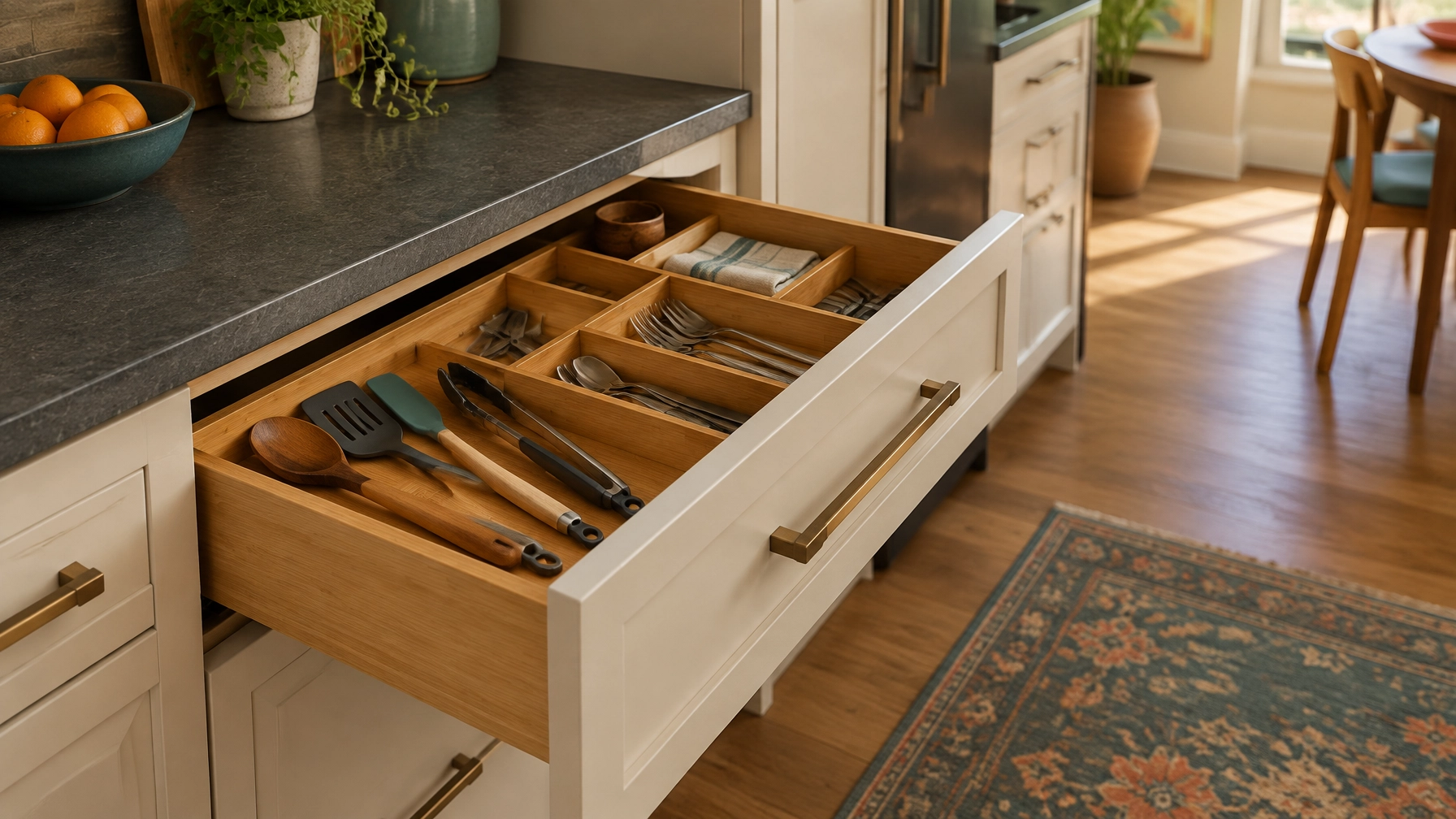
Deep kitchen drawers are useful until smaller tools disappear beneath larger ones, tall drawer walls encourage stacking, and fixed trays leave awkward gaps on either side. Oversized compartments give utensils room to drift, while flatware, cooking tools, food-storage lids, and baking accessories compete for the same space.
A deep drawer is not simply a larger shallow drawer. It needs a different kind of structure.
The goal is not to divide every square inch or fill the drawer from bottom to top. It is to create enough order that frequently used items stay visible, accessible, and easy to put away. In many kitchens, that means a few broad boundaries, one dedicated solution for the messiest category, and some open space left deliberately.
Things Well Chosen may earn a commission from qualifying purchases made through links in this guide, at no additional cost to you.
What Actually Matters in a Deep Drawer Organizer
Measure interior width and depth
Start with the inside of the drawer box, not the cabinet opening or drawer front. Measure wall to wall for usable width, then front to back for usable depth.
This matters because an organizer can look appropriately sized online and still leave an unusable strip along one side, or fail to fit at all. Expandable systems help when drawer dimensions are unusual, but they still have minimum and maximum ranges that need to match your space.
Account for taper, hardware, and drawer stops
The inside of a drawer is rarely a perfect open rectangle. Some drawer boxes taper slightly. Side-mount hardware may reduce usable width or height, and drawer stops can affect how far the drawer opens.
Measure where the organizer will actually sit. If the drawer is narrower toward the back, use the narrowest measurement. The same principle applies to awkward cabinet storage: organize around the fixed parts rather than pretending they are not there. Our guide to under-sink organizers that work around plumbing uses the same approach.
Choose adjustable versus fixed compartments
Fixed compartments work best when the stored items are consistent. Flatware and similarly sized utensils often do well in a defined tray.
Adjustable systems make more sense when the contents vary. Cooking utensils, baking tools, clips, and small gadgets may need different boundaries over time. The useful distinction is flexibility without needless complexity: adjustment should help the organizer fit the drawer or adapt to its contents, not create dozens of tiny decisions.
Avoid excessive stacking
A deep drawer does not need to be filled to its full height. A second level can be useful when the upper layer slides or lifts easily and the lower layer holds less frequently used items. But a tall stack that hides everything underneath only creates a different retrieval problem.
Leave some flexible open space
A completely filled drawer is hard to maintain. New tools have nowhere to go, larger pieces do not fit cleanly, and returning something to its place becomes less obvious.
Open space is not wasted space if it keeps the drawer usable. It is the drawer equivalent of giving everyday kitchen items clear boundaries: organization works better when it supports decisions instead of hiding the fact that there are too many things.
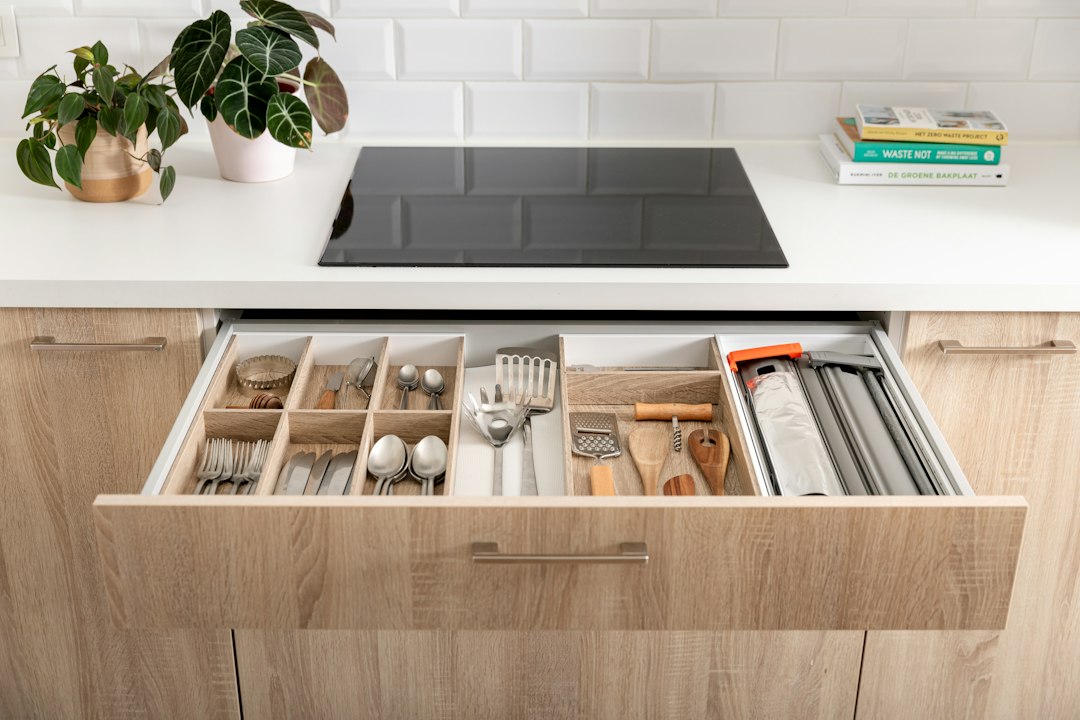
The Best Drawer Organizers for Deep Kitchen Drawers
Pipishell Bamboo Expandable Silverware Drawer Organizer
Best for: Wide drawers where a fixed tray would leave unusable gaps on both sides.
The Pipishell is a low-profile bamboo organizer with an expandable width. The larger version is about 16.7 inches deep and 1.9 inches tall, expanding from roughly 12.9 to 19.7 inches wide.
Why it works: Its advantage is fit. Instead of centering a fixed tray and accepting empty strips along the sides, you can adjust the organizer to the drawer’s usable width. It works well for flatware and everyday utensils without turning the entire drawer into a rigid grid.
What to consider: The low profile organizes the drawer floor but does not make much use of extra vertical space. Dimensions also vary by model, so confirm the version before ordering.
mDesign Expandable Drawer Dividers with Foam Ends, 4-Pack
Best for: Mixed categories that need flexible boundaries rather than fixed compartments.
These adjustable dividers use foam ends and a locking mechanism to create broad zones inside the drawer. Each divider is about 13.25 inches long when compact and expands from roughly 13.4 to 20.1 inches.
Why it works: Their strength is restraint. Two or three dividers can separate cooking utensils, baking tools, and small accessories without forcing every object into its own compartment. If the drawer changes later, the boundaries can move with it.
What to consider: Dividers do not fully contain very small loose items, and they need firm contact with parallel drawer walls to stay put.
Joseph Joseph DrawerStore Bamboo Cutlery, Utensil & Gadget Organizer
Best for: Consolidating flatware and shorter utensils into one deep drawer.
This fixed bamboo organizer combines five overlapping cutlery compartments with three deeper sections for utensils and gadgets. It measures about 15.2 inches wide, 15.7 inches deep, and 2.5 inches tall, and it requires a drawer with at least about 3.25 inches of interior height.
Why it works: The overlapping layout can hold more categories than a conventional flat tray without consuming the entire drawer. It is especially useful when you want one orderly system for flatware plus a few compact tools.
What to consider: The fit is much less forgiving than an expandable tray, so measure carefully. The bamboo should be wiped clean rather than soaked, and the manufacturer recommends occasional food-safe oil.
YouCopia DrawerFit Sliding Drawer Tray
Best for: Deep drawers where frequently used small tools disappear beneath the lower layer.
The DrawerFit creates a sliding upper level inside the drawer. It expands from about 15 to 23.7 inches, measures roughly 7.1 inches wide and 2 inches high, and includes two adjustable dividers.
Why it works: This is one of the more direct ways to use vertical space without creating a permanent stack. Put the small tools you reach for most on the upper tray, then slide it aside when you need access to the drawer floor.
What to consider: It works only when the drawer has enough width, frame support, and clearance below the tray for the items underneath.
YouCopia StoraLid Expandable Container Lid Organizer
Best for: The single messiest category in many deep drawers: food-storage lids.
The StoraLid uses adjustable dividers to hold lids upright instead of letting them collapse into a pile. The expandable version is designed to dedicate one clear zone to lids so the correct size is visible without digging through a stack.
Why it works: This is a good example of solving one difficult category instead of trying to make a universal tray handle everything. If lids are what make the drawer frustrating, giving them their own structure can do more than adding several smaller bins.
What to consider: YouCopia sells more than one StoraLid configuration, so confirm the dimensions and divider height on the exact listing before buying.
Before You Buy: Measure These Three Things
- Interior drawer width: Measure wall to wall inside the drawer box, including the narrowest point if the sides taper. Note any side-mount hardware.
- Interior drawer depth: Measure from the inside front to the back of the drawer, then check whether stops or hardware reduce how far the drawer opens.
- Usable interior height: Measure from the drawer floor to the lowest obstruction or drawer top. Confirm clearance above the tallest item you plan to store.
Nominal cabinet dimensions are not the same as usable space inside the drawer. Compare your measurements with the exact organizer listing, especially when choosing an expandable system or a product that comes in several sizes.
What We Would Skip
Fixed trays that leave unusable gaps on both sides. A fixed organizer can work in a well-matched drawer, but a poor fit turns valuable width into dead space.
Organizers with too many tiny compartments. Small sections may look orderly at first, but they become frustrating when larger utensils or oddly shaped tools have nowhere to go.
Tall stacking systems that hide the bottom layer. A second level is useful only when the lower layer remains reasonably accessible.
Lightweight dividers that constantly shift. Adjustable boundaries are useful only if they hold position during normal use.
Systems that fill the entire drawer. A drawer needs a little flexibility for new items, larger tools, and the ordinary variation of daily use.
The Things Well Chosen Recommendation
The best deep-drawer solution is usually modest structure plus breathing room: a few well-placed boundaries, the most-used items visible, and some open space left deliberately.
Start with one problem category rather than buying a complete system. If wide flatware storage is the issue, an expandable bamboo tray may be enough. If items disappear beneath one another, consider a sliding upper layer. If lids are causing the pile, give them their own upright organizer instead of asking a general-purpose tray to do everything.
A deep drawer does not need to be maximized to be well organized. It needs to make the things you use easiest to find, and leave enough room for the drawer to keep working as your kitchen changes. That is the same standard we use in 7 Small-Kitchen Tools That Actually Earn Their Space: an item should justify the space it occupies by making everyday work easier.