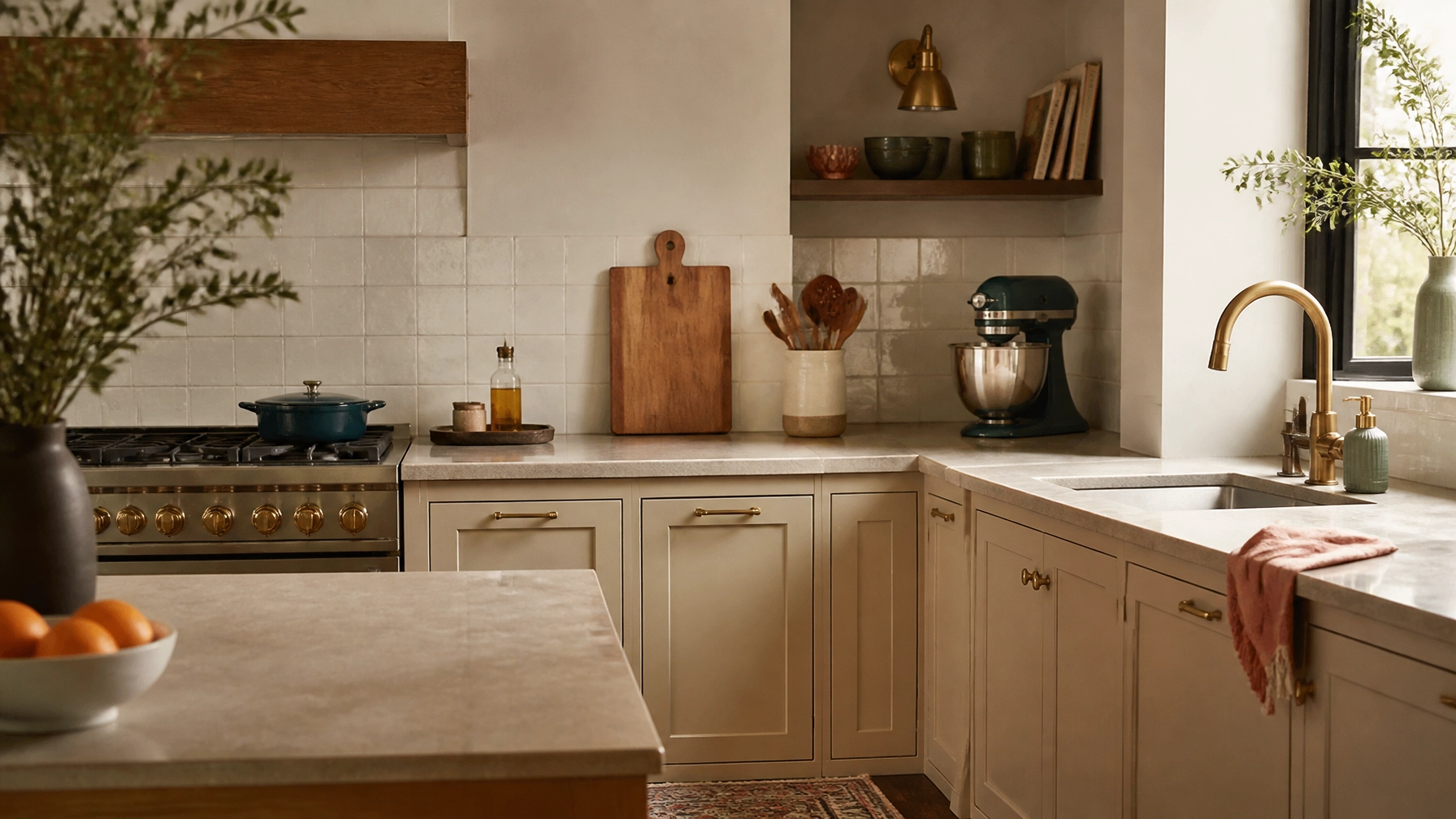
A kitchen counter usually looks cluttered for a simpler reason than people think: not because there is too much on it, but because the things that stay out have no clear boundary. Coffee supplies spread across one end of the counter. Cooking oils end up beside utensils and spice jars. Mail and keys drift in from the entry. A toaster or espresso machine never quite gets put away. Dish soap, hand soap, sponges, and brushes slowly colonize the sink.
That is why a calmer kitchen does not require completely empty counters. It requires decisions. The useful things need defined homes, visual order, and a reason to stay.
Disclosure: Some links in this guide are affiliate links. If you make a purchase through them, Things Well Chosen may earn a commission at no additional cost to you.
1. Start by deciding what deserves counter space
Before you buy anything, decide what has actually earned the right to stay visible.
A useful rule is simple: counter space should be earned by frequency of use. Frequently used objects can stay. Rarely used objects should usually move.
Think in three groups:
- Daily-use items
- Occasional-use items
- Items that are out only because they do not have a real home
Daily-use items often deserve to stay. A coffee maker used every morning, the oil you cook with every night, or dish soap by the sink should not be treated like clutter simply because it is visible.
Occasional items are different. If you use the blender once a week, the waffle maker twice a month, or the food processor only for specific projects, they usually belong in a cabinet, pantry, or nearby shelf instead of claiming work surface every day. The exception is a very heavy appliance you use often enough that moving it constantly would be unrealistic.
The third group is where many counters go wrong. Keys, mail, charging cables, reusable bags, vitamins, pet medications, pens, and receipts often land in the kitchen because it is central and convenient, not because those things belong there.
If you want the counter to feel calmer, clear away what is only passing through. Then decide what remains.
In a tight layout, this editing step matters even more. Our guide to Small Kitchen Fixes That Make a Big Difference offers more ideas for making limited space work without making it feel crowded.
2. Create zones instead of letting useful things spread
Once you know what can stay, give it a boundary.
The point of a kitchen zone is not to buy a matching container for every category. It is to define where each activity belongs so related objects stop drifting across the room.
A coffee zone might include the coffee maker, beans or pods, sugar, and the spoon you actually use. A cooking zone near the stove may hold oil, salt, pepper, and a few most-used utensils. A sink zone may include dish soap, hand soap, a sponge, and maybe a brush or dishcloth.
What matters is not how styled the zone looks. What matters is that coffee supplies stop spreading toward the toaster, cooking oils stop migrating toward the sink, and dishwashing supplies stop taking over the entire corner.
Zones are especially helpful in small kitchens because they protect working space. If prep room is tight, our guide to Best Over-the-Sink Cutting Boards for Small Kitchens may help you gain surface area without crowding the counter further.
3. Use trays as visual boundaries, not decoration
One well-sized tray can make a counter look more ordered because it turns several separate objects into one visual group.
This works especially well for:
- Cooking oils, salt, and pepper
- Coffee supplies
- Dish soap and hand soap
- A few breakfast items that genuinely stay in daily rotation
The benefit is not decorative. A tray creates a border. It tells the eye where that cluster starts and stops.
The risk is buying trays the way people buy baskets: too many, too large, and before deciding what needs to stay out in the first place. A tray should make a zone more disciplined, not give it permission to expand.
If the tray is crowded, if items spill beyond its edge, or if you suddenly have one on every stretch of countertop, it is no longer helping.
4. Use vertical space before sacrificing working surface
When counters are limited, the first question should be whether something can move up rather than out.
A compact riser can create a second level for a small coffee setup. An under-cabinet paper towel holder can remove a bulky everyday object from the work surface. In some kitchens, a narrow wall-mounted rail or magnetic strip can move a frequently used category off the counter entirely.
The point is to recover usable space, not to build a miniature storage wall across the backsplash. If the vertical solution looks industrial, oversized, or busy for the room, it may solve one problem while creating another.
Yamazaki Home Tosca Kitchen Rack
Why we like it: It uses vertical space for a small coffee or cooking zone without requiring a large organizer.
Best for: Small counters where a few daily-use items need a second level.
What to consider: Measure cabinet clearance and backsplash depth; an open rack can make a zone look busier if overloaded.
Kamenstein Perfect Tear Wall Mount Paper Towel Holder
Why we like it: It moves a bulky everyday roll off the counter while keeping it accessible.
Best for: Sink or prep areas with suitable cabinet or wall mounting space.
What to consider: Mounting method and clearance matter; verify the surface and roll size before ordering.
5. Move non-kitchen clutter out of the kitchen
A lot of kitchen clutter is really household overflow.
Mail, keys, charging cables, vitamins, pet medications, pens, receipts, and reusable bags tend to collect on counters because the kitchen is where people pass through, pause, and put things down. But a prettier bowl or canister does not solve that problem if the category itself does not belong there.
The better fix is to relocate the category, not just contain it more attractively. Mail may need a landing spot near the entry. Keys may belong on a hook away from food prep. Chargers and USB cables usually make more sense in an office, drawer, or dedicated charging area. Reusable bags are rarely improved by living on a stool or corner of the counter.
If an item returns to the kitchen every day and genuinely belongs there, give it a specific place. If it does not belong there, move it fully out rather than letting the kitchen become a holding area for the rest of the house.
6. Be realistic about countertop appliances
Appliances are where function and clutter often collide.
Some earn their footprint. A coffee maker used every morning probably does. A toaster may too. A stand mixer might deserve to stay visible if it is very heavy and used often enough that hauling it in and out of storage would make cooking less practical.
Others remain out mostly because they are awkward, because cabinet space is inconvenient, or because once an appliance has sat on the counter for long enough, it starts to feel permanent.
A realistic filter helps:
- How often is it used?
- How much counter space does it take?
- Is it heavy enough that moving it daily would be unreasonable?
- Does the cord add visual clutter?
- Is there nearby storage that is actually usable?
If the answer points toward storage, store it. If the appliance genuinely improves your daily routine, let it stay, but keep its surrounding zone controlled. This is the same logic behind our guide to 7 Small-Kitchen Tools That Actually Earn Their Space: usefulness matters more than novelty, and space should be justified.
7. Control cord clutter
Cords are one of the quickest ways to make a counter feel messy, even when the objects themselves are reasonable.
Usually the problem is not the appliance but the loose black line looping behind it, trailing toward an outlet, or pooling beside the backsplash. Chargers that migrated into the kitchen make it worse.
Start with the low-effort fixes:
- Remove chargers that do not need to live there
- Route appliance cords toward the back
- Shorten extra cable length
- Keep cords away from heat and water
If an appliance stays plugged in all the time, a small cord-management tool can help more than a larger organizer ever will.
Siaomo Cord Organizer for Appliances, 4-pack
Why we like it: It handles the loose cord that makes an otherwise tidy coffee or toaster corner look unfinished.
Best for: Appliances that stay plugged in and have excess cord gathered behind them.
What to consider: Adhesive products need a clean, suitable surface and may not be right for textured finishes or frequently moved appliances.
8. Don’t solve clutter by buying more clutter
This is where many organizing efforts go off course.
Matching containers, large countertop organizers, decorative canisters, stacked shelves, and attractive social-media storage ideas can make a kitchen look intentionally arranged while actually taking up more room and adding more objects to clean around.
The best organizer is often the one that removes something from the counter rather than adding another object to it.
That is why it helps to be skeptical of anything large, highly visible, or unnecessary for your actual routine. Dry goods that fit neatly in cabinets do not need decorative canisters on the counter. A collection of little organizers may create more visual interruption than the items they hold. And if a storage product exists mainly to help you keep more things out, it may be solving the wrong problem.
A few restrained tools can help when they create a real boundary or remove something from the surface entirely.
Joseph Joseph Sink Caddy
Why we like it: It gives wet-use items one defined place and is designed to come apart for cleaning.
Best for: Sink areas where soap, a sponge, brush, and cloth are genuinely used every day.
What to consider: The regular size is about 8.25 inches wide by 5 inches high and 4.5 inches deep, while the large size is about 12 inches wide by 5 inches high and 5.5 inches deep. Measure first; the large version takes meaningful counter space.
Ibyx Acacia Magnetic Knife Strip
Why we like it: It moves knives or other compatible metal tools off a drawer or counter while adding a warmer material than an all-metal strip.
Best for: Kitchens with suitable wall space and a small collection of knives used frequently.
What to consider: Measure the wall and knife clearance, and choose screw mounting if the surface or load makes adhesive uncertain. It is not the right choice if visible wall storage feels busier than a drawer.
What belongs on the counter, in practice
If you want a simple rule, keep only what is used often enough that putting it away would make the kitchen meaningfully less functional.
That usually means some version of:
- One or two daily-use appliances
- A contained cooking zone
- A contained sink zone
- One clear prep area left open on purpose
Everything else should justify itself.
A good kitchen can look calm and still have the things you use every day within reach. It does not need to be empty or magazine-perfect. If you are deciding what stays out, ask one practical question: does this item help me use the kitchen better every day, or is it simply taking up settled space because I have not told it where else to go?