A dog bed fails in two ways: when the dog does not want to use it, and when the room looks worse because it is there. Placement can solve both.
The goal is not to hide the bed. It is to give it a place that feels intentional—somewhere your dog naturally wants to settle and somewhere the bed reads as part of the room rather than something temporarily dropped into it.
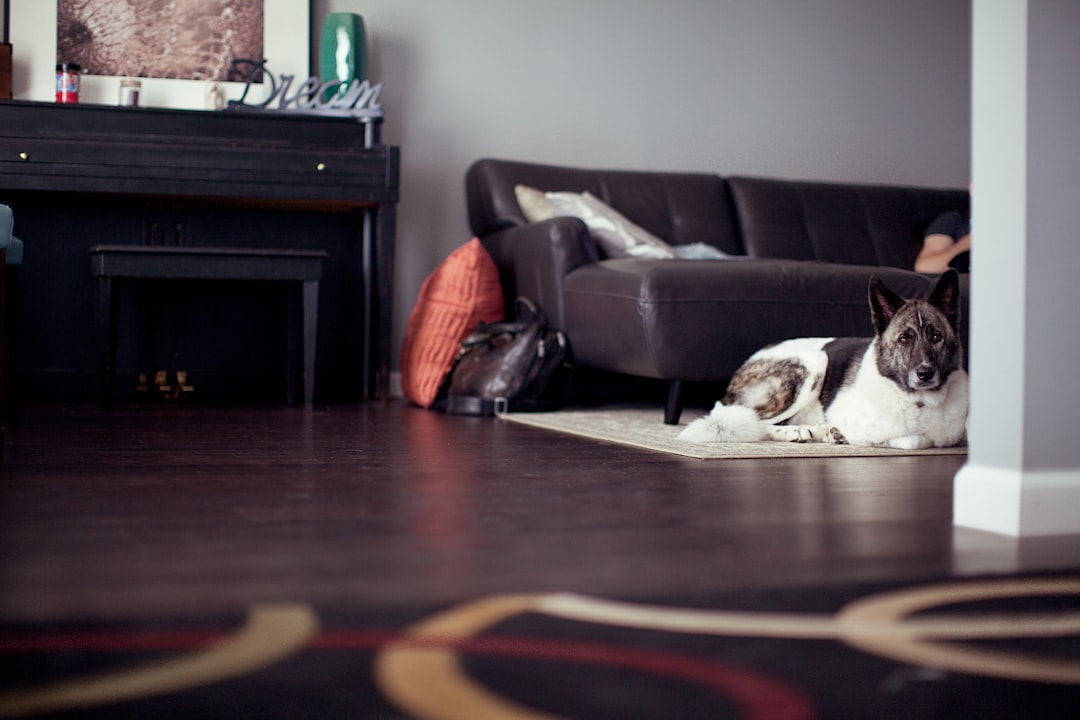
Photo by Jenny Marvin via Unsplash.
Start with where your dog already chooses to sleep
Before moving furniture or choosing a corner, watch your dog for a few days. Most dogs already tell you where they want their resting place to be. They may gravitate toward the end of the sofa, the edge of a rug, a spot near your favorite chair, or a place where they can see both the room and the hallway.
That behavior matters more than an abstract decorating rule. A beautifully placed bed that your dog ignores is not actually well placed. Start with the dog’s preferred zone, then refine the exact position so it works visually.
Treat the bed like a small piece of furniture
The easiest way to make a dog bed look intentional is to stop treating it like an accessory that needs to disappear. Think of it as an ottoman, side chair, floor cushion, or small bench. It needs a relationship to the other furniture around it.
A bed usually looks best when one edge aligns with something already in the room: the front of a sofa, the edge of a rug, the side of a console, or the line created by a pair of chairs. Those quiet alignments make the placement feel deliberate even when nobody consciously notices them.
The best living-room positions
Beside the sofa is often the strongest choice. Your dog stays close to the household, the bed feels connected to the main seating group, and an attractive bed can read almost like an extension of the furniture arrangement.
At the end of a sofa or sectional works particularly well in rooms where the seating floats away from the wall. It gives the dog a defined place without interrupting the central conversation area.
Near a window can be ideal for dogs that like daylight and watching the world outside, provided the location is not excessively hot, drafty, or exposed to constant foot traffic.
Against a console or low cabinet works when you need the bed slightly outside the main seating group. The furniture behind it creates a visual boundary and can make the bed feel anchored rather than stranded in open floor space.
Avoid the traffic lane
Dogs generally want to be near activity without being in the middle of it. Avoid the path between the sofa and kitchen, the main route to a patio door, and narrow passages where feet constantly pass within inches of the bed.
A useful test is simple: if you have to step around the bed several times a day, it is probably in the wrong spot. Shift it just outside the circulation path while preserving the dog’s view of the room.
Use the rug as a visual anchor
If your living room has a large area rug, use it to organize the dog’s space too. A bed can sit entirely on the rug, touch its edge, or align with it. What tends to look awkward is a bed floating a few inches away from every other visual element in the room.
For elevated dog sofas and furniture-style beds, placement beside the rug can work especially well because the raised frame already gives the piece enough visual weight to stand on its own.
Choose a bed that can survive being seen
Placement only gets you so far. If the bed is going to live in the open, its shape, materials, color, and scale matter. Neutral upholstery, wood tones that relate to the rest of the room, restrained silhouettes, and furniture-like proportions are much easier to integrate than oversized beds with bright technical fabrics.
This is why we like the idea behind the Scandi Lounge from Gator & Phoebs: its bentwood frame and upholstered cushion make it read more like a small piece of living-room furniture than conventional pet gear. For smaller spaces or dogs that prefer a more enclosed curve, the Crescent Lounge is the more compact alternative.
A final placement rule
Give your dog a place in the room, not a place outside it. The best location lets them stay connected to the household while remaining comfortably out of the traffic flow. If the bed is attractive enough to belong there, you no longer need to choose between a room that looks finished and a dog that has a place of their own.
Disclosure: Gator & Phoebs is a related brand to Things Well Chosen. We recommend products because they fit the editorial purpose of the guide, and that relationship does not change the price you pay.